Iguana invasion: Ship stowaway leads to international plea deal for Colombian infiltrator

When most folks want to see the Museum for free, they come on our free day (Thursdays from 2 to 5 p.m)

But one of our latest visitors did it differently: He stowed away on a cargo vessel amongst a shipment of tools — all the way from Colombia!

Our new Cockrell Butterfly Center resident, Chico

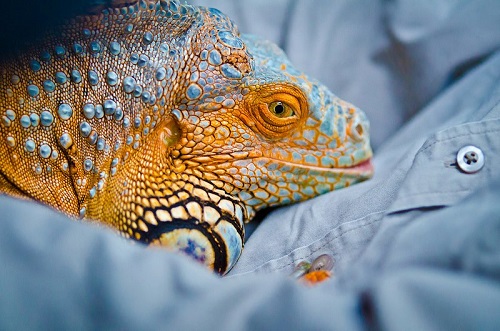
Chico — the ingenious little iguana — was discovered by the U.S. Fish and Wildlife Services and spared prosecution in favor of coming to live with us here at HMNS.

Our new Cockrell Butterfly Center resident, Chico
At just 20.5 inches and estimated to be a year old, Chico is the youngest little lizard we’ve adopted. Our other iguana, Charro (who you probably recognize from the Cockrell Butterfly Center and his many Instagram fans), came to live with us when he was around 7 years and old and just about as large as he is now.

Our new Cockrell Butterfly Center resident, Chico

Charro is 14 years old and has a broken tail, whereas Chico’s in-tact tail is so long that there is actually more tail than lizard!

Chico is too young to yet determine whether he is, in fact, a chico or a chica, so we hedged our bets and gave him (her?) some name flexibility. For now, Chico will be hanging out behind-the-scenes with Butterfly Center staff as he grows big and strong enough to go on display.  As we’ve learned from Iguanas for Dummies (for real), it’s important to give young iguanas lots of “hands-on” experience so they will be people-friendly when they are larger.

We’d love to see Chico become a reincarnation of Sidney, one of our former pet iguanas, who may well have been part-dog. He so loved to be petted that he would occasionally climb into people’s laps!

Our new Cockrell Butterfly Center resident, Chico, receives a pet from Director Nancy GreigIguana know more? Be sure to check back on the Beyond Bones blog periodically as we update you on Chico’s progress!

Win two FREE tickets to the Cockrell Butterfly Center! Read on for details

Update! Our survey closed Monday morning with record responses. Thanks to your feedback, we’re looking forward to continuing to improve our site and getting the latest and greatest HMNS info to you as conveniently as possible. Thanks!

Help me help you by helping us help ourselves. Or something. Can I get Tom Cruise on the line?

Anyhoos — we’ve got a favor to ask, and we’re preemptively returning it. If you help us make our website better with this uber-quick, 10-question online survey, we’ll give you two free passes to your fantastical Cockrell Butterfly Center.

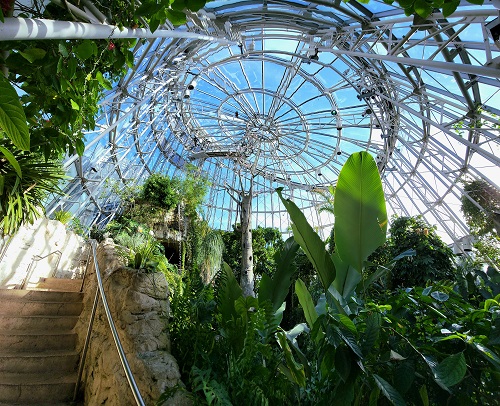
There, you can see cool stuff like this:

HMNS Cockrell Butterfly Center 16
From Flickr user kiriska

This…

(HMNS) The Cockrell Butterfly Center
From Flickr user malts8

And even this…

Charro the Iguana!(Yup. That’s a portly iguana.)

We want to make sure that our content is clear and concise, our website is easy to navigate, and all the great information radiating from our Museum — whether it’s about members’ events, research, what’s coming up or even how the heck to visit — is easy to access.

So pretty please click here and give us your feedback. When you hit submit, you’ll be redirected to a free, printable coupon, and we’ll see you soon to thank you in person!

Visit our butterfly beauties at Primavera through April 7 at the Houston Galleria!

Every year, the Houston Galleria hosts Primavera: a springtime celebration of all things blooming. As in the past, the Museum got in on Primavera this year with a butterfly garden installation:

The Cockrell Butterfly Center staff hits The Galleria for Primavera 2013

Visit our flappers in their fabulous temporary digs through April 7 on the ground floor of Galleria 4, in between Ann Taylor and Gigi’s Asian Bistro.

The Cockrell Butterfly Center staff hits The Galleria for Primavera 2013

Cockrell Butterfly Center Director Nancy Greig (ever-accessorized, below) says we’ve got 20 species hanging out.

The Cockrell Butterfly Center staff hits The Galleria for Primavera 2013Most are rice paper butterflies and longwings, but there are a few lacewings and other beauts in there, as well.

The Cockrell Butterfly Center staff hits The Galleria for Primavera 2013The butterflies are being fed, for the time being, via plastic loofahs soaked in sugar water — the same preferred diet doled out by your average hummingbird feeder.

The Cockrell Butterfly Center staff hits The Galleria for Primavera 2013Want to learn more about butterflies and butterfly gardening? Hit up our semi-annual Plant Sale this April 6 from 9 a.m. to 12 p.m. and learn how to make your own butterfly habitat (greenhouse not included).

The Cockrell Butterfly Center staff hits The Galleria for Primavera 2013

From left, Cockrell staff Lauren Williamson, (THE) Zac Stayton, and Nancy Greig

Buzz or flutter: Who matters when it comes to pollination? (Hint: It’s everybody.)

In economic terms, bees far outstrip butterflies and moths as pollinators. However, there are some plants that are exclusively pollinated by butterflies — especially some wildflowers and garden ornamentals — and several night-blooming species are specifically pollinated by hawkmoths.

Butterflies and moths are members of the insect order “Lepidoptera” — the scaly-winged insects. In addition to the scales covering adults’ wings, Lepidoptera have unique mouth parts as adults: a long, thin, double-barreled, flexible “straw” that is kept coiled up when not in use and extends to reach deep into flowers to extract nectar. This long proboscis means the plants that butterflies and moths typically pollinate have long, thin floral tubes, making the nectar inaccessible to other pollinators with shorter tongues, such as bees or flies.

courtesy of Wikimedia commons

The technical term for butterfly pollination is “psychophily” — psyche being Greek for butterfly.  Butterfly-pollinated flowers are usually brightly colored (butterflies have the widest-known range of color vision in the animal kingdom), especially in yellows, oranges, reds, pinks, and purples or combinations. Scent is apparently not important for butterflies.  However, the flower structure and position is important.  Butterfly-attracting flowers are often produced in showy terminal clusters of smallish blossoms, each with a floral tube that contains nectar and is easily accessible by the butterfly’s long proboscis.

Smaller flowers are usually pollinated by smaller butterflies, which have relatively shorter probosces; large butterflies such as swallowtails have very long probosces and a longer “reach.” Some familiar examples of “classic” butterfly-pollinated flowers are pentas, lantana (indeed many plants in the verbena family), thistles and coneflowers (and many other members of the sunflower or aster family), and milkweeds, among others.  Milkweeds are especially interesting as their pollen is not powdery but occurs in masses or pollinia, each of which bears a little hook that catches on a butterfly’s leg as it probes among the flower clusters.

A few butterflies (mostly the genus Heliconius in the longwing butterfly family) are known to collect pollen on their proboscis and absorb the amino acids from it.  In general, butterflies do not have the “carrying capacity” for pollen as bees do with their hairy bodies.  However, as they move from flower to flower, enough pollen accumulates on their legs or proboscis to get the job done!

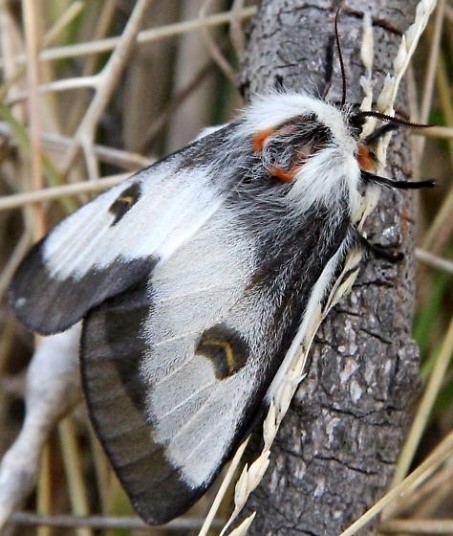
Moth pollination is termed “phalaenophily” (phalaen- meaning moth). A number of moths, including tiger moths, noctuid or owlet moths, and more, visit flowers.  But the best-known pollinators among the moths are the hawkmoths, also known as sphinx moths — the adult form of hornworm caterpillars. These large, powerful fliers are basically the nocturnal equivalent of hummingbirds.  Hawkmoth-pollinated flowers are usually white or pale-colored, making them stand out from the surrounding vegetation at night.  They have long floral tubes to accommodate the very long proboscis of these moths, and many are highly fragrant in the evening, or may only open after dark.  Some examples are moonflower, Brunfelsia, Brugmansia and Datura, night-blooming jasmine, four o’clocks, and evening primrose.

Back to bees:  most of us think “honey bee” when we think of bees, but there are many other bee species, from the familiar bumblebee (not common in our area) to the giant carpenter bees, to tiny sweat bees and colorful leaf cutter bees. These different bee species also have favorite flowers to visit for nectar or pollen (most bees only collect pollen).  For the technophiles, pollination by bees is called “melittophily.”

The wonderful variety of flowers — their shapes, sizes, colors, scents and time of day they bloom, even their placement on a plant — have all evolved to attract a pollinator, often a specific one.  Since plants are rooted in the ground, they depend on things that move, mostly flying things — whether butterfly, moth, bee, fly, hummingbird, bat, or even wind — to transfer their male gametes (in pollen) from flower to flower so that the plants can make more of themselves through forming fruits and seeds.

Next time you are out in your garden, in a field of wildflowers, in a gardening shop, or any place with an abundance of flowers, stop to look more closely at the blooms and think about what pollinator that plant might depend on for its survival.