Up for a challenge? Join us at the George Observatory on Saturday for Rocket Day, get special access to simulated space flight!

Attendees at The George Observatory’s Rocket Day this Saturday morning will have more than water rockets to show for it.

After a morning of learning about rockets and how they work, kids will build their own water rockets and launch them with the help of adult volunteers.

Afterwards, children and their parents can enter The Challenger Center, board the S.S. Observer and embark on a mission to the Moon, participating in real astronaut training and learning how problem-solving can make or break any mission.

Challenger Learning Center

Our simulated space flights are usually reserved for large groups, so Rocket Day represents a rare chance to enjoy simulated space flight for individuals! The mission is most appropriate for ages 7 and up; children 7 to 9 will need adult supervision.

Once you’re done exploring outer space, why not explore Brazos Bend State Park? With six lakes, multiple hiking trails and a fantastic hands-on nature center there is plenty to do and see.

In fact, stay all day and join us Saturday night for the Perseid Meteor Shower Party! Meteors will become visible around 10 p.m. and will become more frequent as dawn approaches. Snacks, blankets and sleeping babes are welcome.

To learn more about Rocket Day and our simulated space missions, please call 281-242-3055 or visit our website.

What: Rocket Day at the George Observatory
When: Saturday, August 11; 10 a.m. to noon
Where: The George Observatory at Brazos Bend State Park. Please note that regular park entrance fees apply: $7 per person, free for kids 12 and under.
How much: $20 per child, free for adults

Proof you can shower once a year and still get people excited: The Perseid Meteor Shower hits Saturday!

Showering once a year? It works for the Perseid cloud!

Each year in mid-August, a stream of debris ejected by the Swift-Tuttle comet, called the Perseid cloud, becomes visible to stargazers — as a meteor shower.

These “shooting stars” are actually streaks of light that occur when tiny dust particles in the comet’s debris trail collide with and are vaporized by the Earth’s atmosphere.

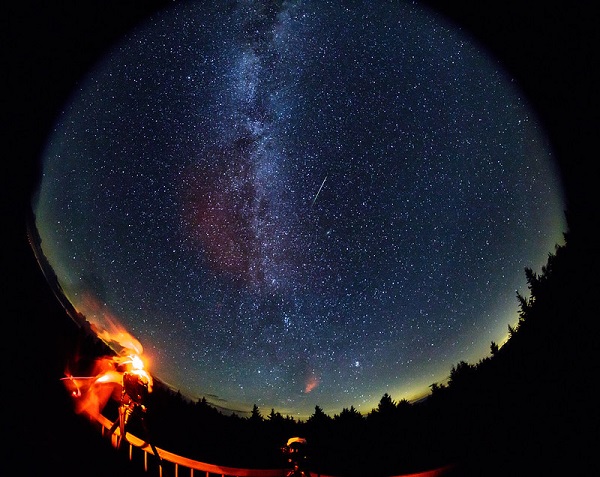
Perseus and Perseid MeteorA composite photo of the 2010 Perseid Meteor Shower

The Perseid Meteor Shower has been observed for approximately 2,000 years and was first recorded by stargazers in the Far East.

It’s best to get out of the city and away from light pollution to view the shower, so the George Observatory at Brazos Bend State Park is hosting a viewing party this Saturday, August 11. Meteors may become visible around 10 p.m., but will grow more frequent as dawn approaches.

Says HMNS Astronomer James Wooten: “You will see more meteors in pre-dawn hours than right after dusk. This is because the Earth is running into the stream of meteors rather than the other way around. As a result, the leading edge of the Earth — the side going from night to day — encounters the meteors. Meteors will seem to radiate from a constellation called Perseus (hence the name “Perseids”). In August, Perseus rises in the northeast at dusk and is high in the north at dawn. Thus, meteors will seem to radiate from the northeast.”

The George will stay open until 2 a.m. August 12 to accommodate people who want to view the full spectacle of this stunning celestial shower.

Normal park entrance fees ($7 per person; free for children 12 and younger) apply. Tickets for the Gueymard Telescope are $5 and go on sale at 5 p.m. Tickets to view the night sky through our 11-inch refractor and other large domes will be available for $5 from 9 p.m. until midnight.

As always, personal telescopes are welcome! The shower is also visible to the naked eye. Lawn chairs, bug spray, snacks and blankets are encouraged.

Go Stargazing! August Edition

Saturn is the only planet visible to the naked eye at night this August.  Face southwest at dusk and you’ll see Saturn near a star of similar brightness—Spica in Virgo.  Saturn is a bit to the right of Spica as you face southwest.   The ringed planet remains well placed for evening viewing and remains in the night sky until late September 2011.

Hubble Images Suggest Rogue Asteroid Smacked Jupiter
Creative Commons License photo credit: NASA Goddard Photo and Video

Mars and Jupiter are in the pre-dawn sky.  Jupiter, set against a background of very dim stars, dominates the southeastern pre-dawn sky and is due south at dawn by the end of the month.  Mars is dimmer and much lower in the east northeast.  It has fully emerged from the sun’s glare and will brighten slightly each morning. Venus is now out of sight.  Superior conjunction (alignment on the far side of the sun) is on August 16.

The Big Dipper is to the left of the North Star, with its handle pointing up.  From that handle, you can ‘arc to Arcturus’ and then ‘speed on to Spica’; those stars are in the west and southwest at dusk.  Antares, brightest star of Scorpius, the Scorpion, is in the south, with the ‘teapot’ of Sagittarius to its left.  Meanwhile, the Summer Triangle is approaching the zenith.  The stars of summer now dominate the evening sky.  In late evening, you can watch the Great Square of Pegasus rise in the east.

Moon Phases in August 2011:

1st Quarter                     August 6, 6:08 a.m.

Full Moon                       August 13, 1:57 p.m.

Last Quarter                  August 21, 4:56 a.m.

New Moon                      August 28, 10:03 p.m.

The annual Perseid Meteor Shower peaks this year on Saturday morning, August 13.  Unfortunately, the moon (full on the 13th) hides all but the very brightest meteors and thus spoils the show.  If you want to see just how many Perseids can outshine the moonlight, the best hours are from roughly 2 a.m. to dawn.

Go Stargazing! August Edition

This month the great planet race continues, as Venus, Mars and Saturn form a triangle in the west.  Watch the triangle change shape each night as Venus overtakes Saturn and then Mars!

Venus is by far the brightest of the three planets.  Face west at dusk and look for a point of light that outshines everything in the night sky.

Saturn and Mars are to the upper left of Venus as August opens.  Mars is below Saturn and a bit to its left.  Although these two planets of similar brightness are much dimmer than Venus, they outshine all the other stars near them.

Observe all three carefully throughout August and watch as their configuration changes.  Mars aligned with Saturn last Saturday (July 31) and now begins to move farther to Saturn’s left.  Venus, moving faster than the other two, continues to approach from the right; it will pass Saturn on August 8.  Venus then continues to gain on Mars as they both move away from Saturn.  Venus finally overtakes Mars on August 19-20.  On the night of August 31, Venus and Mars are to either side of the star Spica in Virgo.

Jupiter is now a late evening object, rising by 11 p.m now and by 8:45 p.m. at month’s end.  It outshines all stars in the sky, so it’s easy to find.  Face east in late evening or south southwest at dawn to see it.

The Big Dipper is in the northwest at dusk. You can extend the curve of its handle to ‘arc to Arcturus’ and then ‘speed on to Spica’.  These stars are in the west at dusk tonight.  Arcturus, by the way, is the fourth brightest star we ever see at night, but the brightest one Americans ever see on an August evening.  Spica is in Virgo, the constellation where this month’s ‘planet race’ occurs.

In the east, look for the enormous Summer Triangle, consisting of the stars Deneb, Vega, and Altair.   This triangle is up all night long from June to early August, hence its name.  Scorpius, the Scorpion, is in the south at dusk.  Sagittarius, the Archer, known for its ‘teapot’ asterism, is to its left.  Between these two star patterns is the center of our Milky Way—the brightest part of that band as wee see it.  On a cloudless night far from the big city, see if you notice the Milky Way glow near the ‘teapot’ of Sagittarius.  In late evening, look for the Great Square of Pegasus rising in the east.

Moon Phases in August 2010:

Last Quarter                        August 3, 12:00 a.m.

New Moon                              August 9, 10:08 p.m.

1st Quarter                           August 16, 1:14 p.m.

Full Moon                              August 24, 12:05 p.m.

Perseid Meteor 8/12/08
Creative Commons License photo credit: aresauburn™

On Friday morning, August 13, the Earth passes through a stream of debris left long ago by Comet Swift-Tuttle.  This produces the Perseid Meteor Shower, one of the best meteor showers each year.   The Perseids occur every year at about this time, producing on average about one meteor per minute.  Keep in mind that even a short period such as a minute can seem longer if you are waiting for something to happen.  Since Earth is running into the meteors, not the other way around, the leading edge of the Earth encounters the shower.  This is the side going from night into day.  Accordingly, we see more meteors as dawn approaches.  Big city lights or the Moon can limit the meteors you see by dimming out fainter ones.  This August, however, the New Moon is on the 10th, giving us a skinny crescent on the 12th which sets long before the shower really gets going.  The main challenge, then, is to avoid city lights.

If skies that night are clear, our George Observatory will open Thursday night, August 12 at 9pm and remain open until dawn for observing the shower.  If you come out to George or go elsewhere, you’ll want to lie on your back (to see as much of the sky as at once as possible) and orient yourself towards the constellation Perseus.  (The shower is called the ‘Perseids’ because they seem to radiate from that constellation.)  Perseus rises in the northeast at dusk and is high in the north at dawn.