Seeing Stars with James Wooten: May 2013

Jupiter is now lower in the west at dusk. Face west at dusk and look for the brightest thing there (unless the Moon is also there), as Jupiter outshines all other stars we ever see at night. It appears slightly lower in the sky each night, though, and is gone by the end of the month. As Jupiter leaves the evening sky, Mercury and Venus emerge to join it on Memorial Day weekend. The three planets form a tight triangle May 25-26; Venus and Jupiter are just one degree apart on May 27.

Saturn is now an evening object, shining in the southeast at dusk.  Although not as bright as Jupiter, it does outshine the stars around it, so you can’t miss it.

Mars is still out of sight on the far side of the Sun this month.

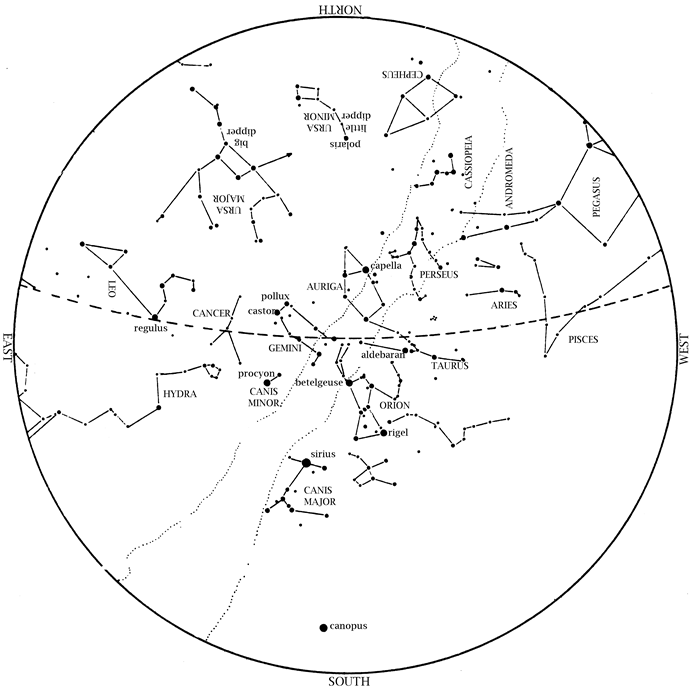
Sky Map: May 2013A swath of brilliant winter stars sets in the west at dusk. Orion, the Hunter, is still visible in the west as May begins. His two dogs, represented by Sirius and Procyon, are to his left.  To Orion’s right is Taurus, the Bull, with Aldebaran as its eye. Gemini, the Twins, are above Orion. The Big Dipper is above the North Star, with its handle pointing to the right. From that handle, you can ‘arc to Arcturus’ and then ‘speed on to Spica’; those stars are in the east and southeast at dusk. Leo, the Lion, passes almost overhead in late evening.

As Orion and Taurus set, look for Antares, brightest star of Scorpius, the Scorpion, to rise in the southeast. At the same time, Vega, brightest star of the Summer Triangle, appears low in the northeast. These stars remind us that summer is on the way.

Moon Phases in May 2013:

Last Quarter                 May 2, 6:16 am; May 31, 1:59 pm
New                              May 9, 7:31 pm
1st Quarter                   May 17, 11:35 pm
Full                                May 24, 11:26 pm

The New Moon of May 9 passes in front of the Sun, causing an eclipse. However, the Moon is too far from the Sun to block it completely; the result is an annular eclipse, in which a ring of the Sun’s disk surrounds the Moon. Also, the event is visible only along a path that begins in Australia and extends across the Pacific.

On most clear Saturday nights at the George Observatory, you can hear me do live star tours on the observation deck with a green laser pointer. If you’re there, listen for my announcement. I generally do one such tour on short May nights.

To enjoy the stars in any weather from the comfort of the HMNS Planetarium, click here for a full schedule.

Seeing Stars with James Wooten: April 2013

Jupiter is now lower in the west at dusk. Face west at dusk and look for the brightest thing there (unless the Moon is also there), as Jupiter outshines all stars we ever see at night.

Saturn shifts from morning to evening sky this month. It rises at about 9:45 p.m. on April 1 and is in the south-southwest by dawn. On April 28, Earth passes between the Sun and Saturn, causing Saturn to rise at dusk and set at dawn. In this alignment, called opposition, Saturn is up literally all night long.

Sky Map April 2013

Venus and Mars are still out of sight on the far side of the Sun this month.  Mars is behind the Sun (in conjunction with the Sun) on April 17.

Brilliant winter stars shift toward the west during April. Dazzling Orion is in the southwest at dusk. His three-starred belt is halfway between reddish Betelgeuse and bluish Rigel.  Orion’s belt points northward to Aldebaran in Taurus the Bull. This winter and spring the Bull also contains Jupiter. To Orion’s upper left are the twin stars Castor and Pollux, marking the heads of Gemini, the Twins. You can find Sirius, the brightest star we ever see at night, by drawing a line from Orion’s belt towards the south.  To Orion’s left, forming a triangle with Sirius and Betelgeuse, is Procyon, the Little Dog Star.

Meanwhile, the stars of spring are high in the east and overhead. Look for Leo, the Lion, high in the east at dusk.  Also, extend the Big Dipper’s handle to ‘Arc to Arcturus’ and then ‘speed on to Spica’ — these stars are in the east.

Moon Phases in April 2013:

Last Quarter                  April 2, 11:38 pm
New                               April 10, 4:38 am
1st Quarter                    April 18, 7:31 am
Full                                April 25, 2:59 pm

On most clear Saturday nights at the George Observatory, you can hear me do live star tours on the observation deck with a green laser pointer. If you’re there, listen for my announcement.

Saturday, April 13, is a special “Observe the Planets” night at the George. Come join us in observing Jupiter and Saturn!

To enjoy the stars in any weather from the comfort of the HMNS Planetarium, click here for a full schedule.

Reflect, refract, get the facts! Join us for a telescope class April 6 at the George Observatory

Scope out your new telescope at one of our informative telescope classes.

Our refracting/reflecting scope class April 6 at 3 p.m. will teach beginner astronomers how to set up their ‘scopes, as well as some star formations to look for.

via the Beautmont Enterprise
Image via the Beaumont Enterprise

Then, at 4:30 p.m., our go-to/computerized telescope class will lend expert advice on how to align your ‘scope. Stay late and let the public view the stars through your new telescope on the observation deck, and see how much fun it can be to volunteer at the George!

Both classes are $25 for members, $30 for the public.

Seeing Stars with James Wooten: March 2013

Jupiter is almost overhead at dusk, but now a little toward the west. Face high in the west at dusk and look for the brightest thing there (unless the Moon is also there), as Jupiter outshines all stars we ever see at night.

Saturn remains in the morning sky this month.  Look for it in the south/southwest at dawn.

Venus and Mars are on the far side of the Sun and out of sight this month. Venus passes behind the Sun (at superior conjunction) on March 28.

Sky Map: March 2013

Brilliant winter stars shift toward the southwest during March. Dazzling Orion is almost due south at dusk. His three-starred belt is halfway between reddish Betelgeuse and bluish Rigel. Orion’s belt points up to Aldebaran in Taurus the Bull. This winter and spring the Bull also contains Jupiter.

To Orion’s upper left are the twin stars Castor and Pollux, marking the heads of Gemini, the Twins. You can find Sirius, the brightest star we ever see at night, by drawing a line from Orion’s belt towards the horizon. To Orion’s left, about level with Betelgeuse, is Procyon, the Little Dog Star.

From Sirius, look a little bit to the right and then straight down to the horizon. If your southern horizon is clear of clouds and tall earthly obstacles, you’ll see Canopus, the second-brightest star ever visible at night. This star is so far south that most Americans never see it and many star maps made in the USA omit it. (You must be south of 37 degrees north — the latitude of the USA’s Four Corners — for Canopus to rise). As you view Canopus, keep in mind that the sky we see depends on our latitude as well as on time of year and time of night.

Joining the winter stars are stars of spring rising in the east.  Look for Leo, the Lion at dusk. Later in the evening, extend the Big Dipper’s handle to ‘Arc to Arcturus’ and then ‘speed on to Spica’; these stars rise at about 10 p.m. in early March but by 9 p.m. on the 31st.

March 2013 evening skies feature an extra special object — comet Pan-STARRS, our first naked-eye comet since Hale-Bopp back in 1997!  Observers south of the equator have already been observing Pan-STARRS, but the comet has been invisible to us because it has been south of the Sun in our sky. That is beginning to change as Pan-STARRS nears its closest approach to the Sun late on March 9.

Like all comets, Pan-STARRS will be at its brightest as it comes closest to the Sun.  At the same time, Pan-STARRS will be coming up through the plane where the planets orbit and thus will be much easier for us to see in mid-March. You can start looking in western twilight as early as March 7 if you have a low, unobstructed horizon. The comet may be slightly easier to see on March 12 and 13, when the crescent Moon is nearby. Once Pan-STARRS appears in the western dusk sky, it shifts towards the north (to the right as you face west) each night, until it fades and returns to the Sun’s glare in April.

As always, scientists are unsure how bright Pan-STARRS will get.  It now seems that it won’t be as spectacular as was Hale-Bopp in 1997. However, southern observers are seeing it naked-eye, and so should we. The comet could be about as bright as average stars such as those in the Big Dipper, but may be dim enough that you need a dark site to see it, especially once the Moon gets bigger.

Ultimately, though, we’ll have to wait and see. Sky and Telescope has a helpful finder chart here.

Moon Phases in March 2013:
Last Quarter                  March 4, 3:54 pm
New                               March 11, 2:53 pm
1st Quarter                    March 19, 12:26 pm
Full                                March 27, 4:29 am

At 6:01 a.m. on Wednesday, March 20, the Sun is directly overhead at the equator.  This therefore is the vernal (spring) equinox, a day when everyone on Earth has the same amount of daylight. After this date, our gradually lengthening days become longer than our nights, and we go into springtime. South of the equator, days have been shortening.  For them, this equinox marks the point when night becomes longer than day, and the onset of autumn.

Sunday, March 10, is the second Sunday of this month. Therefore, Daylight Saving Time begins at 2 a.m. this morning (the time officially goes from 1:59 to 3 a.m.)  Don’t forget to spring forward by advancing all clocks one hour on Saturday night, March 9!

On most clear Saturday nights at the George Observatory, you can hear me do live star tours on the observation deck with a green laser pointer.  If you’re there, listen for my announcement. This Spring Break, the George will be open to the public on Tuesday night, March 12, and Thursday night, March 14.

To enjoy the stars in any weather from the comfort of the HMNS Planetarium, click here for a full schedule.