Party with the planets this Memorial Day: See the closest gathering of any three planets until 2021

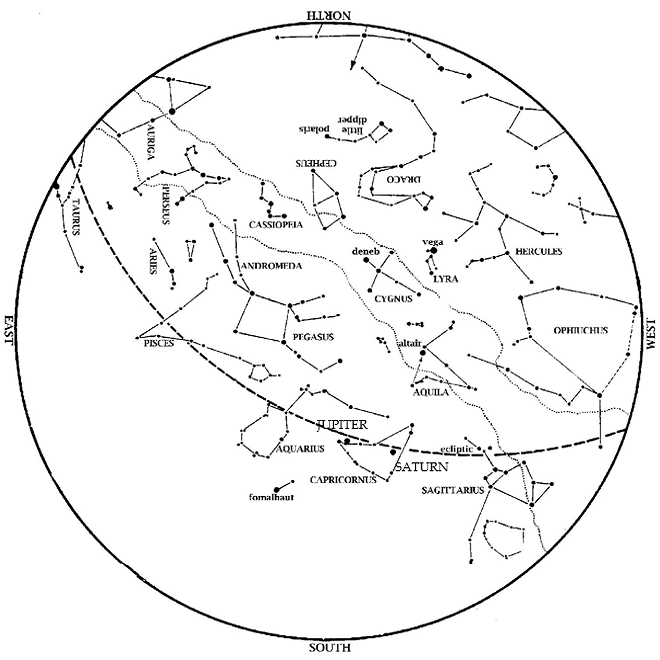
As you celebrate this upcoming Memorial Day weekend, take some time to appreciate an interesting sight in the sky — the gathering of Mercury, Venus and Jupiter low in the west-northwest at dusk.

Right now, you notice Jupiter setting in the west at dusk. It outshines all stars we ever see at night, so it’s quite visible even during twilight. Because Earth is about to pass around the far side of the Sun from Jupiter’s position, we see Jupiter get a little lower to the horizon each night this month.

Image courtesy of earthsky.orgImage courtesy of earthsky.org

Perhaps, if your northwest horizon is clear enough, you will also notice Venus below and a bit to the right of Jupiter. In late January 2013, we lost sight of Venus as it began to pass around the far side of the Sun. Now in May 2013, it has begun to come from behind the Sun so that we see it again. Unlike Jupiter, then, Venus gets a little higher in the sky each night. Venus will be an evening star for the rest of 2013.

Mercury is usually invisible to us because it is always in the Sun’s general direction. Only rarely is Mercury far enough from the Sun in our sky to be above the horizon while the Sun is not. June 2013 is one of those exceptional moments. As May 2013 ends, Mercury also enters the evening sky alongside Venus.

On May 23, Mercury is directly beside Venus as both planets are 5 degrees (the width of three fingers, held at arm’s length) to the lower right of Jupiter. By May 26, Mercury and Venus have caught up with Jupiter to form a triangle about two degrees wide. (Jupiter and Mercury are side by side; Venus is the ‘apex’ pointing down.)  On the next night, Memorial Day, we see Venus and Jupiter less then one degree apart, with Mercury about two degrees above them. This will be the closest gathering of any three planets until January 2021.

Keep in mind that to observe any of this, you need a northwest horizon utterly clear of buildings, trees, or other obstacles. You can test your chosen observation site by watching a sunset there. The three planets will appear in the same direction in which the Sun sets. If you can watch sunset all the way until the Sun sets, you’ve picked a good site for observing the May 2013 planet gathering.

Keep in mind that Venus and Jupiter outshine all stars we ever see at night. This means that they become quite visible in twilight. Once you’ve picked a good observation spot, you can begin looking for Venus and Jupiter in twilight (around 8:30 p.m.) without waiting until twilight ends (about 9:15 p.m. at the end of May in Houston).

During June 2013, Mercury and Venus remain in the western sky at dusk, while Jupiter drops into the glare of the Sun. At first, the faster Mercury races out ahead of Venus and is thus higher in the sky. By mid-month, though, Mercury has begun to come around to our side of the Sun, so we see it slow down and head back towards the Sun.  On June 18, Mercury and Venus are side by side once again. Then Mercury drops back into the Sun’s glare, leaving Venus as the planet visible in the west at dusk for the rest of 2013.

Seeing Stars with James Wooten: June 2012

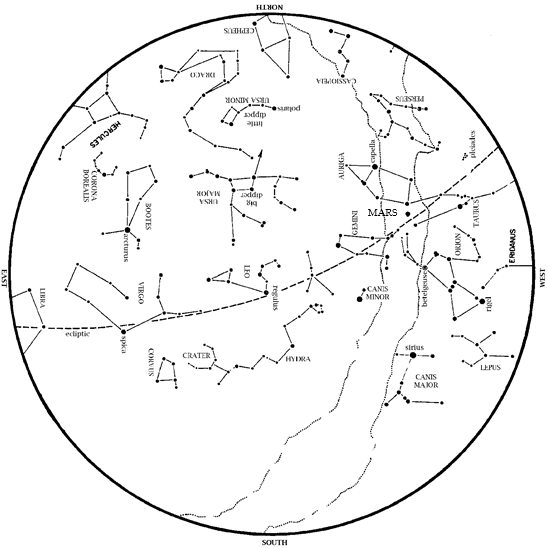
Mars remains an evening object this month. Face south at dusk and look for a reddish star to the left of Regulus in Leo. However, Mars continues to fade a little bit each night as Earth pulls away from it. This summer, you can watch Mars quickly approach Saturn, which it will pass on August 15.

Saturn is now in the south at dusk this month. Saturn is just above the star Spica in Virgo.

Meanwhile, Jupiter emerges into the morning sky. Look for it low in the east/northeast at dawn; it outshines all stars in that direction.

sky map june 2012

Venus joins Jupiter in the morning sky by late June.  On June 5, Venus passes directly in front of — or transits — the Sun (see below). In the weeks after that, Venus shifts into the morning sky as it pulls ahead on its faster orbit.  The emergence of Venus into the morning sky is quite dramatic — the brightest celestial object aside from the Sun and Moon is noticeably higher each morning. By June 30, Venus will be close to Jupiter at dawn.

The Big Dipper is above the North Star, with its handle pointing up. From that handle, you can “arc to Arcturus” and then “speed on to Spica;” those stars are in the south at dusk. Leo the Lion is high in the west at dusk.

Antares, brightest star of Scorpius the Scorpion, is in the southeast, with the “teapot” of Sagittarius rising behind it.  The Summer Triangle has fully risen in the northeast; the stars of summer are here.

Mercury takes Venus’ place as an evening star during June. Having just emerged from behind the Sun, Mercury enters the western sky at dusk, where it remains for the rest of the month.  Of course, Mercury is not nearly as bright as Venus, but it still outshines most stars.  Watch the sunset, then look for the brightest “star” in western twilight.  This is Mercury.  In July, it fades and leaves the evening sky.

Like last year, George Observatory opens to the public on Friday nights as well as Saturday nights during the summer.  Also, we’re adding a special “Sun-day” program on Sunday afternoons beginning June 10 that will feature solar observing on sunny days and Sun-related Discovery Dome shows if cloudy!

Moon Phases in June 2012:
Full                               June 4, 6:11 a.m.
Last Quarter                  June 11, 5:42 a.m.
New                              June 19, 10:02 a.m.
1st Quarter                     June 27, 10:29 p.m.

On Tuesday, June 5, Venus passes between Earth and Sun, and is not up at night. This happens every 584 days, and is normally no big deal. This time, however, the alignment is exact, and we can see Venus transit the Sun.  You can come observe this event at any of our three museum facilities.

Transit of Venus at HMNS

At 6:07 pm on Wednesday, June 20, the Sun is directly overhead at the Tropic of Cancer — the farthest point north where this is possible. This means the Earth’s North Pole is tilted towards the Sun as much as possible. Therefore, this date is the summer solstice. In the Northern Hemisphere, we have more daylight and less night than on any other date.

On most clear Saturday nights at the George Observatory, you can hear me do live star tours on the observation deck with a green laser pointer. If you’re there, listen for my announcement.

To enjoy the stars in any weather from the comfort of the HMNS Planetarium, click here for a full schedule.

Seeing Stars with James Wooten: Join us for a once-in-a-lifetime viewing of Venus in transit June 5

Mark your calendars for Tuesday, June 5, people.

The Houston Museum of Natural Science invites the public to observe a rare and special event on the afternoon of Tuesday, June 5. On that date, the planet Venus will transit the Sun, appearing as a black dot against the Sun’s disk. Weather permitting, the Museum will provide telescopes with filters to safely observe the Sun near the sundial just outside the Museum’s main entrance, as well as at the George Observatory and at our museum in Sugar Land.

586px-Venustransit_2004-06-08_07-49
A photograph taken of the 2004 transit of Venus at 3:39 p.m. Hong Kong time from Tuen Mun, New Territories, Hong Kong.

What’s the big deal?

On June 5, Venus passes the Earth on its faster orbit around the Sun. Venus’s orbit is between ours and the Sun, so it passes between Earth and Sun about once every 584 days. However, since Venus’s orbit is tilted by about five degrees to our own, it usually “misses” the Sun by a wide margin as seen from Earth. But on June 5, Venus lines up almost exactly with the Earth and the Sun. This causes Venus to appear as a black dot silhouetted on the Sun’s disk, an event called a “transit.” Only Mercury and Venus can transit the Sun because they are the only planets that pass between the Earth and Sun.

How often does this happen?

Transits of Venus occur in pairs eight years apart — and then not again for more than a century. Because of the way Venus’s orbit is aligned, transits occur only in June or December. This is the second of this pair of transits (the other, not visible in Houston, occurred in June 2004). The next transit visible here in Houston will occur the morning of December 8, 2125.

So how do I see Venus on the Sun’s disk?

Venus remains in front of the Sun for about six hours. Its disk will be over 30 times smaller than the Sun’s — roughly the size of a sunspot. To view the transit, we will provide solar telescopes and solar projection devices at the Museum, at the George Observatory, and at our Museum in Sugar Land. We will also have special solar glasses (the same kind used to watch eclipses) for purchase at all three locations.

As the transit begins, Venus will appear as a small dot on the right side of the Sun low in the western sky. Unlike any sunspots present, Venus will move quite noticeably across the Sun’s disk. Also, sunspots can be irregular in shape, while the disk of Venus is round. The transit begins in the afternoon at 5:09 p.m. and will still be in progress at sunset at 8:19 p.m.

If the Sun was still up, we would see Venus exit the Sun’s disk at 11:31 pm. Due to the trees surrounding Hermann Park and the deck at George Observatory, we will observe at these sites until 7:00 pm. At Sugar Land, however, the clear horizon means we can observe the Sun until 8:00 p.m.

At all three Museum locations, we will have free planetarium previews of the Venus transit, illustrating why it happens and why it is so rare. We’ll also take a virtual voyage to the planet. These special shows will be offered at 4:00, 4:15, 4:30, and 4:45 p.m. in preparation for the event beginning at 5:09 p.m.

Transit of Venus at HMNS

This is the last transit of Venus that anyone alive today will ever be able to see, so don’t miss it!

Do not attempt to observe the Sun with the naked eye or through an unfiltered telescope. Failure to use appropriate filtration may result in permanent eye damage or blindness.

Go Stargazing! October Edition

Jupiter is up all night long by month’s end.

 That’s because on Friday night, October 28, Earth passes between the Sun and Jupiter.  In this alignment (‘opposition’) Jupiter rises at dusk and sets at dawn.  Already, Jupiter is a late evening object rising just after 8:30 pm on October 1.  Face east at the appropriate time and look for the brightest thing there—that’ll be Jupiter.   Once up, Jupiter remains up the rest of the night, so the King of Planets continues to dominate the western pre-dawn sky. 

Jupiter as Seen by Voyager 1
Creative Commons License photo credit: Undertow851

Venus begins to emerge from the Sun’s glare late this month.  Look for it low in the west southwest in twilight, especially as Halloween approaches.  This is the beginning of Venus’ apparition as evening star; it gets higher and easier to see for the rest of this year and is spectacular for about the first half of 2012. 

Mars is now a bit higher in the east at dawn.

It has now brightened to rival first magnitude stars such as Regulus in Leo. As it moves through dim Cancer and towards Leo, Mars is quite identifiable.  Saturn is behind the Sun and invisible.  It is directly in line with the Sun on October 13.  We thus say Saturn is in conjunction with the Sun on that date. 

Antares, brightest star of Scorpius, the Scorpion, sets in the southwest during twilight, with the ‘teapot’ of Sagittarius to its upper left.  Meanwhile, the Summer Triangle is virtually overhead.  As the stars of summer shift to the west, those of autumn fill the eastern sky.   Watch the Great Square of Pegasus rise in the east.  Note that we look towards the center of our galaxy when we face between Scorpius and Sagittarius.  When facing the Great Square or especially south and east of that, we face out of the plane of our galaxy, a direction where there are fewer bright stars.

Assyrian or Babylonian
Creative Commons License photo credit: Ed Bierman

That’s why the large expanse of sky rising under Pegasus seems devoid of bright stars.

For this reason, ancient Babylonians designated this broad area of sky as the ‘Celestial Sea’, and filled it watery constellations.  The only bright star in this whole expanse of our sky is Fomalhaut in the southeast, which marks the mouth of the Southern Fish.  Between the ‘teapot’ of Sagittarius and Jupiter (in Aries, the Ram), are three dim zodiacal constellations—Capricornus, the Sea Goat, Aquarius, the Water Carrier, and Pisces, the Fish.  The giant sea monster Cetus rises under Pisces.

Moon Phases in October 2011:
First Quarter October 3, 10:15 pm
Full October 11, 9:06 pm
Last Quarter October 19, 10:31 am
New October 26, 2:56 pm

Saturday, October 8, is our annual Astronomy Day at the George Observatory.

First Light
Creative Commons License photo credit: Space Ritual

 Come join us anytime from 3 to 10 pm.  On Astronomy Day, it is free to look through even the main domes at George.  Before dusk, we will have solar observing, Challenger Center simulations, outdoor and indoor presentations (beginning at 4) and many other activities! On most clear Saturday nights at the George Observatory, you can hear me do live star tours on the observation deck with a green laser pointer.  If you’re there, listen for my announcement.