Seeing Stars with James Wooten: April 2013

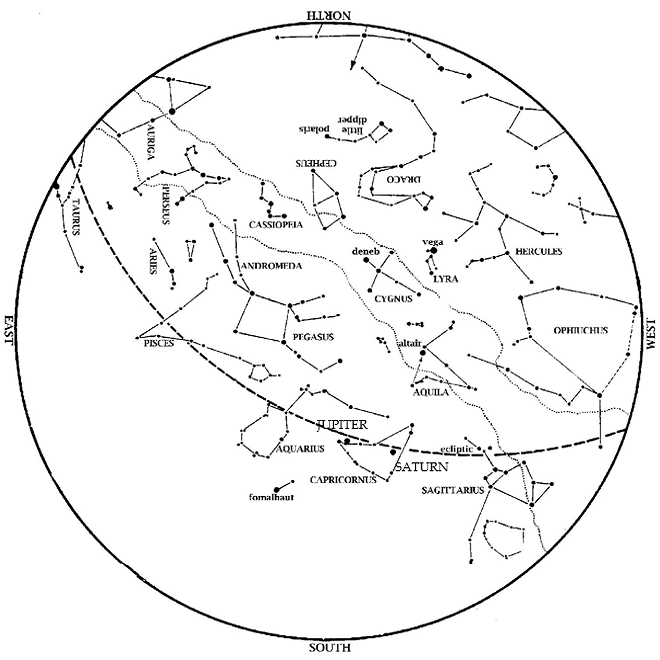
Jupiter is now lower in the west at dusk. Face west at dusk and look for the brightest thing there (unless the Moon is also there), as Jupiter outshines all stars we ever see at night.

Saturn shifts from morning to evening sky this month. It rises at about 9:45 p.m. on April 1 and is in the south-southwest by dawn. On April 28, Earth passes between the Sun and Saturn, causing Saturn to rise at dusk and set at dawn. In this alignment, called opposition, Saturn is up literally all night long.

Sky Map April 2013

Venus and Mars are still out of sight on the far side of the Sun this month.  Mars is behind the Sun (in conjunction with the Sun) on April 17.

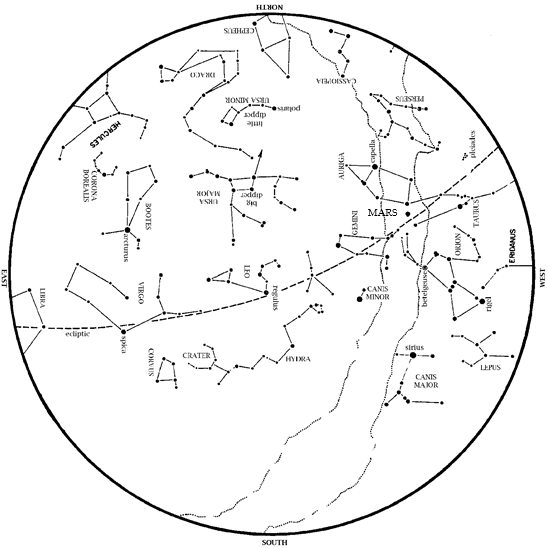
Brilliant winter stars shift toward the west during April. Dazzling Orion is in the southwest at dusk. His three-starred belt is halfway between reddish Betelgeuse and bluish Rigel.  Orion’s belt points northward to Aldebaran in Taurus the Bull. This winter and spring the Bull also contains Jupiter. To Orion’s upper left are the twin stars Castor and Pollux, marking the heads of Gemini, the Twins. You can find Sirius, the brightest star we ever see at night, by drawing a line from Orion’s belt towards the south.  To Orion’s left, forming a triangle with Sirius and Betelgeuse, is Procyon, the Little Dog Star.

Meanwhile, the stars of spring are high in the east and overhead. Look for Leo, the Lion, high in the east at dusk.  Also, extend the Big Dipper’s handle to ‘Arc to Arcturus’ and then ‘speed on to Spica’ — these stars are in the east.

Moon Phases in April 2013:

Last Quarter                  April 2, 11:38 pm
New                               April 10, 4:38 am
1st Quarter                    April 18, 7:31 am
Full                                April 25, 2:59 pm

On most clear Saturday nights at the George Observatory, you can hear me do live star tours on the observation deck with a green laser pointer. If you’re there, listen for my announcement.

Saturday, April 13, is a special “Observe the Planets” night at the George. Come join us in observing Jupiter and Saturn!

To enjoy the stars in any weather from the comfort of the HMNS Planetarium, click here for a full schedule.

Go Stargazing! August Edition

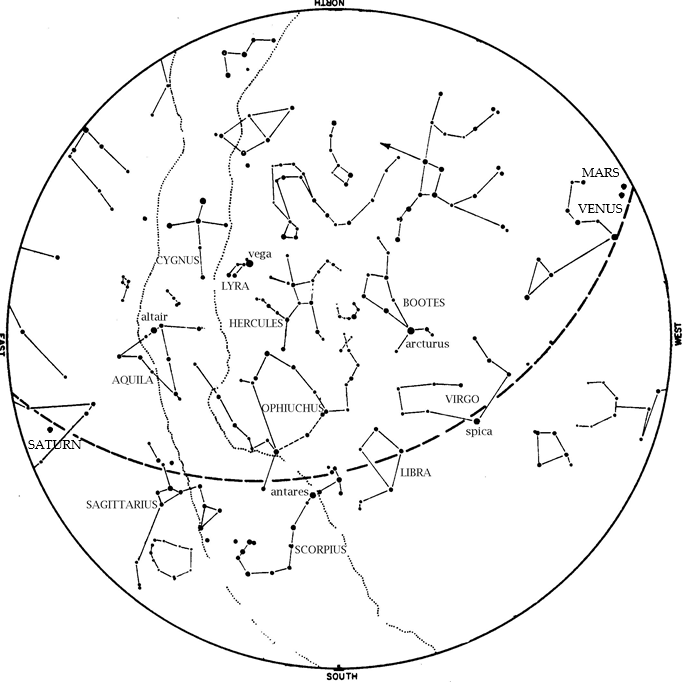
Saturn is the only planet visible to the naked eye at night this August.  Face southwest at dusk and you’ll see Saturn near a star of similar brightness—Spica in Virgo.  Saturn is a bit to the right of Spica as you face southwest.   The ringed planet remains well placed for evening viewing and remains in the night sky until late September 2011.

Hubble Images Suggest Rogue Asteroid Smacked Jupiter
Creative Commons License photo credit: NASA Goddard Photo and Video

Mars and Jupiter are in the pre-dawn sky.  Jupiter, set against a background of very dim stars, dominates the southeastern pre-dawn sky and is due south at dawn by the end of the month.  Mars is dimmer and much lower in the east northeast.  It has fully emerged from the sun’s glare and will brighten slightly each morning. Venus is now out of sight.  Superior conjunction (alignment on the far side of the sun) is on August 16.

The Big Dipper is to the left of the North Star, with its handle pointing up.  From that handle, you can ‘arc to Arcturus’ and then ‘speed on to Spica’; those stars are in the west and southwest at dusk.  Antares, brightest star of Scorpius, the Scorpion, is in the south, with the ‘teapot’ of Sagittarius to its left.  Meanwhile, the Summer Triangle is approaching the zenith.  The stars of summer now dominate the evening sky.  In late evening, you can watch the Great Square of Pegasus rise in the east.

Moon Phases in August 2011:

1st Quarter                     August 6, 6:08 a.m.

Full Moon                       August 13, 1:57 p.m.

Last Quarter                  August 21, 4:56 a.m.

New Moon                      August 28, 10:03 p.m.

The annual Perseid Meteor Shower peaks this year on Saturday morning, August 13.  Unfortunately, the moon (full on the 13th) hides all but the very brightest meteors and thus spoils the show.  If you want to see just how many Perseids can outshine the moonlight, the best hours are from roughly 2 a.m. to dawn.

Go Stargazing! July Edition

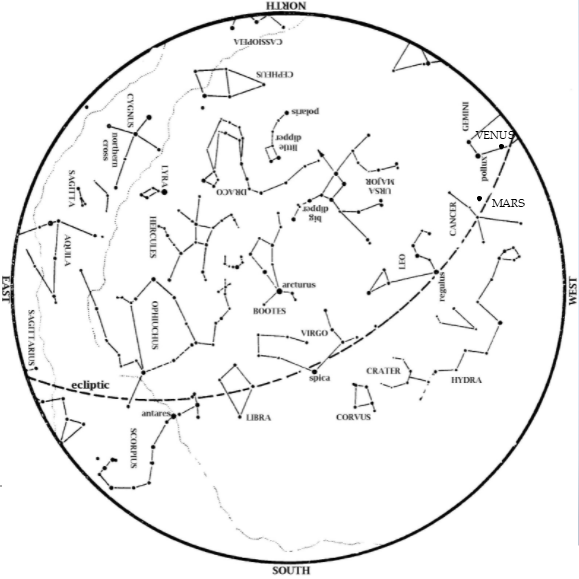
Saturn is the only planet visible to the naked eye in the evening skies of July, 2011.  Face south-southwest at dusk, and you’ll see Saturn near a star of similar brightness—Spica in Virgo.  Saturn is a bit to the right of Spica as you face southwest.   The ringed planet remains well placed for evening viewing, and remains in the evening sky until late September 2011.

Hubble Images Suggest Rogue Asteroid Smacked Jupiter
Creative Commons License photo credit: NASA Goddard Photo and Video

Mars and Jupiter are now higher in the pre-dawn sky.  Jupiter, set against a background of very dim stars, dominates the eastern sky at dawn.  Mars is dimmer and much lower in the east northeast.  It has fully emerged from the sun’s glare, and will brighten slightly each morning.  Venus is now out of sight, as it is passing around the far side of the sun from our perspective.

The Big Dipper is above the North Star, with its handle pointing up.  From that handle, you can ‘arc to Arcturus’ and then ‘speed on to Spica’; those stars are in the southwest at dusk.  Leo, the Lion, sets in the west at dusk.

Antares, brightest star of Scorpius, the Scorpion, is in the south, with the ‘teapot’ of Sagittarius rising behind it.  The Summer Triangle has fully risen in the northeast.  The stars of summer now dominate the evening sky.

Moon Phases in July 2011:

New Moon                       July 1, 4:02 p.m.

1st Quarter                     July 8, 9:09 p.m.

Full Moon                        July 15, 3:12 p.m.

Last Quarter                  July 23, 6:48 a.m.

Winter Solstice Lunar Eclipse
Creative Commons License photo credit: Bruce McKay~YSP

The new moon of July 1 partially blocks the sun, but only as seen from the Antarctic.  No one will get to see a total eclipse because the moon’s full shadow, or umbra, passes just below the Earth.

As we celebrate our independence this July 4, Earth will be at aphelion (at its greatest distance from the sun).  The precise time is 10 a.m.  Perihelion, the Earth’s closest approach to the sun, occurs in January.  Earth has perihelion and aphelion because its orbit is not a circle but an ellipse with an eccentricity (out-of-roundness) of about 1.6%.  Such a small variation, however, exerts no significant influence on our seasons, as you can determine for yourself by stepping outside.  The 23.5 degree tilt of Earth’s axis, on the other hand, is a much more dominant effect.  The very high midday sun of July ensures long days and baking heat in Houston and across much of the Northern Hemisphere.

By popular demand, our George Observatory will open to the public Fridays and Saturdays this summer (except July 8, due to a prior booking).  The Discovery Dome, our traveling planetarium, will be set up each of these Fridays to show films throughout the evening.

Go Stargazing! June Edition

Saturn
Creative Commons License photo credit: Elsie esq.

Saturn is the only planet visable to us at night this June.  Face south at dusk, and you’ll see Saturn near a star of similar brightness — Spica in Virgo.  Saturn is significantly higher in the sky than Spica and a bit to its right as you face south.   The ringed planet is now well placed for evening viewing, and remains in the evening sky until late September 2011.

Mars and Jupiter are now higher in the pre-dawn sky.  Jupiter, set against a background of very dim stars, dominates the eastern sky at dawn.  Mars is dimmer and much lower in the east northeast.  It has fully emerged from the sun’s glare, however, and will brighten slightly each morning.  Venus does not rise until morning twilight.  Look for it very low in the east northeast as day breaks.

The Big Dipper is above the North Star, with its handle pointing up.  From that handle, you can “arc to Arcturus” and then “speed on to Spica;” those stars are in the south at dusk.  Leo the Lion, is high in the west at dusk.

Antares, brightest star of Scorpius, the Scorpion, is in the southeast, with the ‘teapot’ of Sagittarius rising behind it.  The Summer Triangle has fully risen in the northeast.  The stars of summer are here. 

Moon Phases in June 2011:

New Moon                    June 1, 4:02 p.m.

1st Quarter                  June 8, 9:09 p.m. 

Full Moon                     June 15, 3:12 p.m.

Last Quarter               June 23, 6:48 a.m.

Red Light...
Sunset
Creative Commons License photo credit: Kıvanç Niş

The full moon of June 15 passes through the Earth’s shadow, causing a total eclipse of the Moon. Unfortunately, we miss out on that one, too, as the eclipse occurs during our daylight hours.  Anyone in the Eastern Hemisphere, though, can observe a central (and therefore especially long) total eclipse of the moon. 

At 12:17 p.m. on Tuesday, June 21, the sun is directly overhead at the Tropic of Cancer, the farthest point north where this is possible.  This makes the midday sun as high in our sky as possible and gives us more daylight than on any other day of the year.  This moment is, therefore, the summer solstice.  However, the earliest sunrise for us is the morning of June 11 and the latest sunset is on June 30.  Those of us who sleep through sunrise and witness sunset may get the impression that the days are lengthening all the way to the end of the month.

By popular demand, our George Observatory will open to the public not only on Saturdays, but also all Friday nights in June and July (except July 8).  The Discovery Dome, our traveling planetarium, will be set up each of these Fridays to show films throughout the evening.