Seeing Stars with James Wooten: June 2012

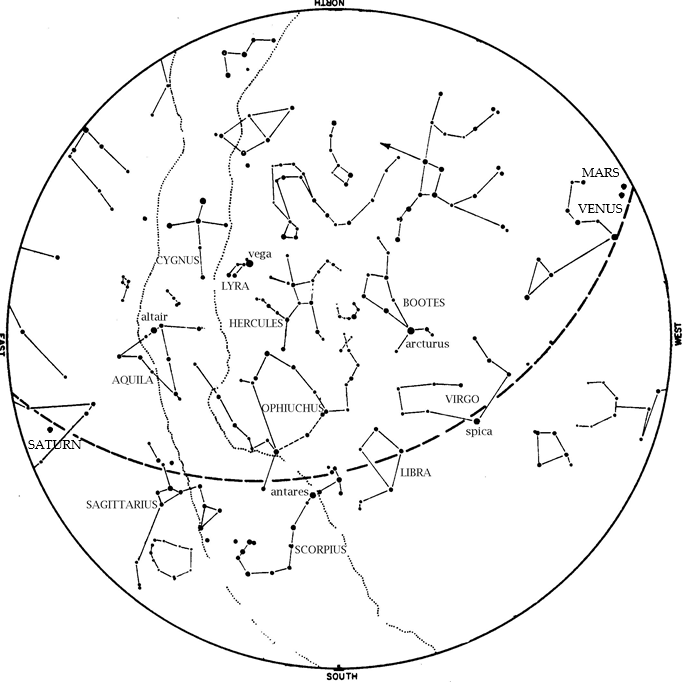
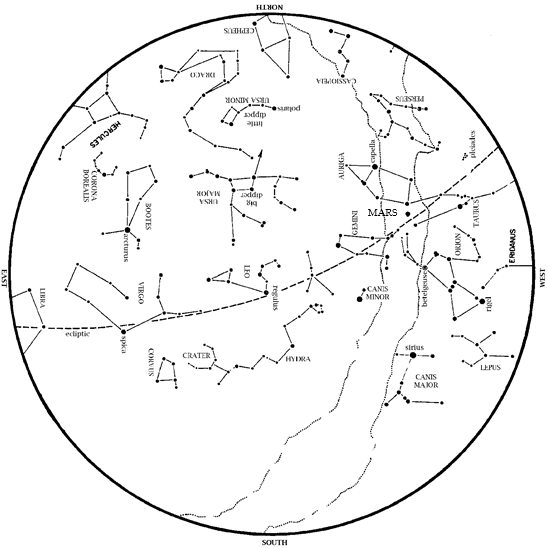
Mars remains an evening object this month. Face south at dusk and look for a reddish star to the left of Regulus in Leo. However, Mars continues to fade a little bit each night as Earth pulls away from it. This summer, you can watch Mars quickly approach Saturn, which it will pass on August 15.

Saturn is now in the south at dusk this month. Saturn is just above the star Spica in Virgo.

Meanwhile, Jupiter emerges into the morning sky. Look for it low in the east/northeast at dawn; it outshines all stars in that direction.

sky map june 2012

Venus joins Jupiter in the morning sky by late June.  On June 5, Venus passes directly in front of — or transits — the Sun (see below). In the weeks after that, Venus shifts into the morning sky as it pulls ahead on its faster orbit.  The emergence of Venus into the morning sky is quite dramatic — the brightest celestial object aside from the Sun and Moon is noticeably higher each morning. By June 30, Venus will be close to Jupiter at dawn.

The Big Dipper is above the North Star, with its handle pointing up. From that handle, you can “arc to Arcturus” and then “speed on to Spica;” those stars are in the south at dusk. Leo the Lion is high in the west at dusk.

Antares, brightest star of Scorpius the Scorpion, is in the southeast, with the “teapot” of Sagittarius rising behind it.  The Summer Triangle has fully risen in the northeast; the stars of summer are here.

Mercury takes Venus’ place as an evening star during June. Having just emerged from behind the Sun, Mercury enters the western sky at dusk, where it remains for the rest of the month.  Of course, Mercury is not nearly as bright as Venus, but it still outshines most stars.  Watch the sunset, then look for the brightest “star” in western twilight.  This is Mercury.  In July, it fades and leaves the evening sky.

Like last year, George Observatory opens to the public on Friday nights as well as Saturday nights during the summer.  Also, we’re adding a special “Sun-day” program on Sunday afternoons beginning June 10 that will feature solar observing on sunny days and Sun-related Discovery Dome shows if cloudy!

Moon Phases in June 2012:
Full                               June 4, 6:11 a.m.
Last Quarter                  June 11, 5:42 a.m.
New                              June 19, 10:02 a.m.
1st Quarter                     June 27, 10:29 p.m.

On Tuesday, June 5, Venus passes between Earth and Sun, and is not up at night. This happens every 584 days, and is normally no big deal. This time, however, the alignment is exact, and we can see Venus transit the Sun.  You can come observe this event at any of our three museum facilities.

Transit of Venus at HMNS

At 6:07 pm on Wednesday, June 20, the Sun is directly overhead at the Tropic of Cancer — the farthest point north where this is possible. This means the Earth’s North Pole is tilted towards the Sun as much as possible. Therefore, this date is the summer solstice. In the Northern Hemisphere, we have more daylight and less night than on any other date.

On most clear Saturday nights at the George Observatory, you can hear me do live star tours on the observation deck with a green laser pointer. If you’re there, listen for my announcement.

To enjoy the stars in any weather from the comfort of the HMNS Planetarium, click here for a full schedule.

Go Stargazing! October Edition

Jupiter is up all night long by month’s end.

 That’s because on Friday night, October 28, Earth passes between the Sun and Jupiter.  In this alignment (‘opposition’) Jupiter rises at dusk and sets at dawn.  Already, Jupiter is a late evening object rising just after 8:30 pm on October 1.  Face east at the appropriate time and look for the brightest thing there—that’ll be Jupiter.   Once up, Jupiter remains up the rest of the night, so the King of Planets continues to dominate the western pre-dawn sky. 

Jupiter as Seen by Voyager 1
Creative Commons License photo credit: Undertow851

Venus begins to emerge from the Sun’s glare late this month.  Look for it low in the west southwest in twilight, especially as Halloween approaches.  This is the beginning of Venus’ apparition as evening star; it gets higher and easier to see for the rest of this year and is spectacular for about the first half of 2012. 

Mars is now a bit higher in the east at dawn.

It has now brightened to rival first magnitude stars such as Regulus in Leo. As it moves through dim Cancer and towards Leo, Mars is quite identifiable.  Saturn is behind the Sun and invisible.  It is directly in line with the Sun on October 13.  We thus say Saturn is in conjunction with the Sun on that date. 

Antares, brightest star of Scorpius, the Scorpion, sets in the southwest during twilight, with the ‘teapot’ of Sagittarius to its upper left.  Meanwhile, the Summer Triangle is virtually overhead.  As the stars of summer shift to the west, those of autumn fill the eastern sky.   Watch the Great Square of Pegasus rise in the east.  Note that we look towards the center of our galaxy when we face between Scorpius and Sagittarius.  When facing the Great Square or especially south and east of that, we face out of the plane of our galaxy, a direction where there are fewer bright stars.

Assyrian or Babylonian
Creative Commons License photo credit: Ed Bierman

That’s why the large expanse of sky rising under Pegasus seems devoid of bright stars.

For this reason, ancient Babylonians designated this broad area of sky as the ‘Celestial Sea’, and filled it watery constellations.  The only bright star in this whole expanse of our sky is Fomalhaut in the southeast, which marks the mouth of the Southern Fish.  Between the ‘teapot’ of Sagittarius and Jupiter (in Aries, the Ram), are three dim zodiacal constellations—Capricornus, the Sea Goat, Aquarius, the Water Carrier, and Pisces, the Fish.  The giant sea monster Cetus rises under Pisces.

Moon Phases in October 2011:
First Quarter October 3, 10:15 pm
Full October 11, 9:06 pm
Last Quarter October 19, 10:31 am
New October 26, 2:56 pm

Saturday, October 8, is our annual Astronomy Day at the George Observatory.

First Light
Creative Commons License photo credit: Space Ritual

 Come join us anytime from 3 to 10 pm.  On Astronomy Day, it is free to look through even the main domes at George.  Before dusk, we will have solar observing, Challenger Center simulations, outdoor and indoor presentations (beginning at 4) and many other activities! On most clear Saturday nights at the George Observatory, you can hear me do live star tours on the observation deck with a green laser pointer.  If you’re there, listen for my announcement.

Ride on a Shooting Star: Space Fuel

After the decimation suffered during World War II, mankind took a look at all the new technologies he had created to fight the war and turned his gaze towards the stars. From the late 1940’s this onward and upward reach has helped to fuel the engines of our ingenuity, but what has fueled those stellar ambassadors that now dot our solar system and beyond.

654 - Galaxies - Seamless Texture
Creative Commons License photo credit: Patrick Hoesly

To move from the surface of the earth to this new ocean a rocket must be moving about 7 miles per second. That takes a lot of energy. Many different propellants have been used. The very first rocket fuels were a mix of kerosene and liquid oxygen. Alcohol, hydrogen peroxide, and liquid hydrogen have also been used, in addition to solid fuels. They can provide thrust without the need for all the refrigeration and containment equipment that some of the liquid fuels, such as liquid hydrogen and oxygen, require.

Once the probe is beyond the reach of the atmosphere there is no way to change what’s on board.

The probe cannot drop by the local Radio Shack and pick up a fresh pair of AA batteries. While the probe is being built on Earth, the engineers must make sure that they provide a source of power that will give the probe the right amount of power.

Too little power and the scientific instrumentation won’t work; too much power could over heat the probe. On board chemical batteries can be used, but they take space that could be used for scientific instruments. Solar panels can be used, but only up to a certain distance from the sun. Beyond the orbit of Jupiter, probes need an internal power supply that will last for years.

They use the heat from radioactive decay of fissionable isotope.

Sputnik 1 in Orbit Sep 10-4-57
Creative Commons License photo credit: FlyingSinger

Early probes like Sputnik and Explorer 1 used chemical batteries to power their systems. In March of 1958 Vanguard 1, the 4th artificial satellite and the 1st powered by solar power, was launched. Probes with solar panels have more space on board for scientific instruments than probes that use only chemical batteries. Probes sent into the inner solar system (sun to Mars) are almost all powered using solar arrays.

Mariner 2, the first USA probe to Venus, suffered the loss of one of its solar arrays, but because it was closer to the sun, it was able to operate using only one solar array. No American manned space craft have made use of solar arrays yet (the new Multi-Purpose Crew Vehicle may), the Russian Soyuz spacecraft have used them since 1967.

The International Space Station (ISS) is the largest man-made structure outside our atmosphere.

Larger than a football field (but smaller than a football pitch), this outpost orbits the earth every hour and a half. It is also powered completely by solar power. Past the atmosphere, solar power becomes more practical and more consistent (there is no night in space). Because of the orbital path of the ISS, it is eclipsed by the earth for 30 minutes out of every hour and a half. The station makes use of rechargeable batteries to make sure it is never without power.

From a Distance
Creative Commons License photo credit: Undertow851

As the probes go farther and farther away from the sun, the light that can reach them is less and less.

Until August of 2011, no probe to Jupiter had ever been powered just by solar panels. Juno, the latest probe to Jupiter, has the largest solar arrays given to a deep space probe and the first probe to Jupiter to use solar arrays.

Jupiter receives only 4% of the sunlight we enjoy on Earth. Advances in solar technology have now made it practical to use solar panels out 5 Astronomical Units (AUs) from the sun. All other deep space probes have used a radioisotope thermoelectric generator (RTG).

A RTG works by converting the heat from the decay of a radioactive fuel into electricity. American probes have been using Plutonium 238 (an isotope of Plutonium) since the late 1960’s. It has a half life of about 88 years. RTGs have powered all our interplanetary probes (the Voyagers and Pioneers and soon to be New Horizons). However, NASA has begun to run out of fuel for the RTGs and the creation of more is full of political and safety considerations.

There he goes, after an all day long work.
Creative Commons License photo credit: giumaiolini

The technology that we’ve made to go out to the ‘verse with will also help us here on the cool, green hills of earth. RGTs have been used, mainly by Russia, to provide power for off the grid light houses. Advances in solar panels for space are used down here on Terre Firma. With the reliably of solar power in space, there are even attempts to construct orbital solar collectors to beam down electricity. There will be from heaven to Earth more than is dreamt of.

Water on Mars?

On August 5, 2011, Science Magazine published a paper, announcing that astronomers had observed unusual features on the northward slopes of cliffs in Mars’ southern hemisphere. Strangely, these narrow, dark features are seasonal; they appear in spring and summer and disappear as fall approaches. So far, the explanation that best fits the evidence is that briny water sometimes flows on Mars.

Fourth Planet From The Sun

Mars, the fourth planet from the Sun, is just over half as big across as the Earth and almost one-ninth as massive. Mars takes almost two Earth years (687 days to be exact) to complete an orbit which, on average, is half again as big as ours.  However, Mars’ orbit is over five and a half times as eccentric, or out-of-round, as ours.  Unlike on Earth, then, the variation in Mars’ distance from the Sun is significant enough to influence its climate.

Similarly to Earth, Mars rotates on its axis once every 24.6 hours.  This axis is tilted by about 24.5 degrees, giving Mars seasons similar to those on Earth, whose axis is tilted by 23.5 degrees.  In its interior, Mars has no liquid outer core and therefore lacks a global magnetic field to deflect the solar wind away from its atmosphere.

Red Marble vs. Blue Marble
Creative Commons License photo credit: Bluedharma

These factors contribute to a climate where pure liquid water is highly unstable and cannot persist for long.

Due to its greater distance from the Sun, Mars is much colder than Earth.  Mars Global Surveyor measured temperatures ranging from zero to -113 degrees Celsius (32 to -170 oF).  Temperatures at the surface can be above freezing in summer, particularly in Mars’ southern hemisphere, because summertime there coincides with perihelion.  Even so, temperatures just one meter above the surface can be cooler than on the ground, as measured by Mars Pathfinder.  Nighttime temperatures at the poles can approach -200 oF, colder than the coldest temperature ever recorded in Antarctica (-129 oF).

Further, lack of a magnetic field means that Mars was unable to retain much of an atmosphere. 

Earth’s atmosphere is over 200 times as massive as that of Mars.  Although it is over 95% composed of carbon dioxide, such a tenuous atmosphere produces no significant greenhouse effect to raise temperatures on Mars.  Except at the very lowest elevations, the very thin Martian atmosphere exerts a pressure lower than the triple point of water; even on rare occasions when the temperature might be above freezing, ice sublimates rather than melting.

Why Salt Water Might Exist On Mars

Salt water, however, freezes at a lower temperature than pure water, and thus might remain liquid for brief periods on Mars.  Salt water (or brines), then, might explain observations made by NASA’s Mars Reconnaissance Orbiter, which has orbited Mars since November 2006.  Images from this orbiter’s High Resolution Imaging Science Experiment show features called Recurring Slope Lineae (RSL).  They are in Mars’ southern hemisphere, on the north (equator facing) slopes such as crater walls.  The RSLs appear in local springtime and persist until local autumn, when they vanish.  Only 0.5 meters to 5 meters wide, they can become hundreds of meters long during Mars’ southern summer.

Life Requires Water

We have always been interested in finding signs of water on planets other than Earth because life as we know it requires water to exist.  As the only other planet in our solar system with conditions even approaching ours, Mars is among the first places we looked for life beyond Earth.  The search for water, and thus possible life, has been a major goal of our robotic missions to Mars, including the Viking program in the 1970′s.

We have established that H2O exists on Mars in other phases. 

Mars’ polar caps are cold enough for dry ice (frozen carbon dioxide), but they contain water ice as well.  In 2005, the European Space Agency’s Mars Express satellite snapped a picture of an ‘ice lake’ in the bottom of a crater near Mars’ north pole. In 2008, the Phoenix lander revealed water ice in trenches dug by its robotic arm.  In 2004, the rover Opportunity took photos of water ice clouds and was also at times covered in frost, indicating water vapor had frozen onto the rover.

For liquid water, however, scientists had looked into Mars’ past.  Vastitas Borealis, a huge region between four and five kilometers lower than the mean elevation of Mars, fills much of Mars’ northern hemisphere.  It is also flatter, with craters in the Vastitas Borealis much rarer than on the rest of Mars.  Many scientists subscribe to the Mars Ocean Hypothesis, which posits that about 3.8 million years ago, Vastitas Borealis was the site of a vast ocean covering about one-third of Mars’ surface, which then either evaporated or froze into the ground as Mars’ environment ceased to support large bodies of liquid water.  For one thing, the size and shape of craters in Vastitas Borealis suggest that sublimation of water ice played a role in weathering them.  Also, there are networks of valleys resembling river systems on Earth, as if they once flowed into the ancient ocean.

A large water ocean could have persisted on early Mars

To support this ancient ocean, there are indications that Mars once had enough carbon dioxide to exert up to one bar of atmospheric pressure.  Under this higher pressure, combined with higher temperatures (due to the greenhouse effect) a large water ocean could have persisted on early Mars.  However, Mars lacks a global magnetic field; its atmosphere interacts directly with the solar wind.  This interaction would have gradually dispersed Mars’ atmosphere into space, a process we can observe today.  As the atmosphere went away, Mars would have lost its ocean due to the end of the greenhouse effect and the lower air pressure.

The existence of this ancient water ocean on Mars is not yet fully established; competing explanations such as wind erosion or liquid methane are not yet excluded.  Still, a former ocean 3.8 milllion years in Mars’ past has been our best bet for liquid water on the Red Planet.

Liquid Water on Mars Today

Until now, that is.  If confirmed by future observations, August 2011 would mark the first published evidence of liquid water on Mars today.  Yet many questions remain.  We know neither the source of the salty water, nor the precise mechanism that brings it to the surface, not to mention whether or not such water might contain germs.  So, the science we’re doing  at Mars continues, as the new questions raised make Mars an even more fascinating world to study.