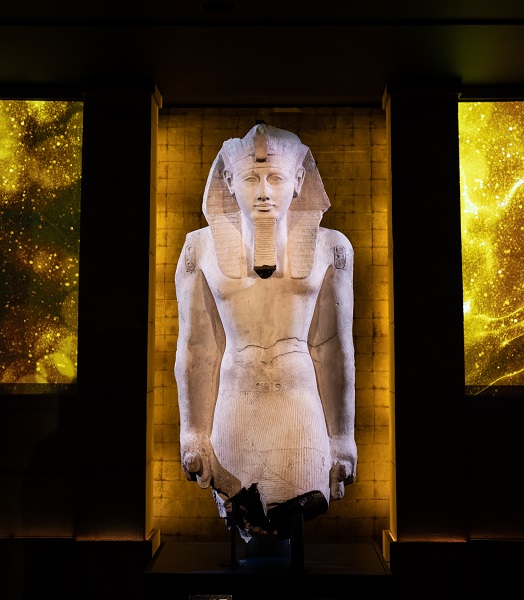
The place is the famous Siwa Oasis in Egypt. The time is 525 B.C. Ancient Egypt is but a former shadow of itself. Tutankhamun has been dead and buried for 800 years (and his tomb plundered twice already by now). Slowly but surely, Egypt’s power was fading as it was drawn into the orbit of mightier empires in the region.
During the 6th century B.C., Egypt was plagued by massive internal unrest. Egyptian armies were involved in expeditions heading south into Nubia, as well as into southern Palestine. Greek-speaking mercenaries were now gainfully employed in Egypt. Greek merchants even received permission to settle in their own city, Naucratis, in the Nile delta. Things were definitely different in Egypt and they were about to take a turn for the worse in 525 B.C.
Cambyses II, ruler of the Persian Empire, invaded Egypt in that year. Psammetichus III faced the Persian army at the great frontier fortress of Pelusium eastern gateway into Egypt. The Egyptian forces and their Greek mercenaries were no match. The king fled to Memphis, where he was captured and taken to Susa, the Persian capital. One can only imagine what his fate was.
Greek historian Herodotus, father of history writing, lived a mere 75 years later and wrote about this momentous event. He relates how the Persian king sent off an army – of 50,000 soldiers no less – to destroy the oracle located in the Siwa Oasis. It is alleged that the oracle had predicted the king’s downfall, and Cambyses was having none of it. Yet the oracle proved to be right. The army never reached its destination and was swallowed up by the desert. Cambyses did eventually bite the dust as well in 522 B.C.
Then the sands of time and the desert covered up the story of the army that set off to destroy the oracle. Eventually, it was relegated to the realm of legend. Numerous expeditions were launched to find it, but without success.
Until….
Until relatively recent discoveries in the desert now seem to have located the unfortunate Persian army. Relatively recent indeed; it appears that for the last 13 years two Italian brothers, Angelo and Alfredo Castiglioni, undertook five expeditions in search of Cambyses’ troops. They claim they have found good evidence of Persian-era and Persian-style military gear in the Egyptian desert. The media are buzzing with the news. Numerous online videos have popped up on the subject, showing the Italian and Egyptian teams working at a rock shelter in the desert and finding Persian arrow heads, a partial sword or dagger and bits and pieces of horse gear.
Is this for real? Are we dealing with something else altogether? Time will tell. For now, it appears very likely that the lost army has been found. As they say, stay tuned. I am sure a documentary will soon appear on TV. I wonder if a book is coming out soon as well….
In upcoming movies (yes, plural), we are foretold the end of the world, set to happen in 2012. One trailer shows graphic images of massive tidal waves crashing over the Himalayas, wiping out all life on the planet. If one scans late night TV programs (think along the lines of preachers who come on in the wee hours of the morning) as well as the internet, you will find a great variety of references to this date and the impending doom associated with it.
Why? What in the world is this all about?
Many people think the Maya predicted the world to end in 2012.
I see two things going on here: hype and reality. There is a huge disconnect between the two. Let’s start with reality: timekeeping in the Americas before the arrival of the Europeans. Then we will address the fantasy world that has been built on top of that historical reality.
Among the Prehispanic, or Pre-Columbian people of the Americas, the ancient Maya were accomplished astronomers. Unlike us, the Maya had a different perception of time. They considered time passing in terms of cycles, we think of it as a never-ending linear progression of days growing into weeks, months, years, etc. With the Maya, time was counted in units of twenty, a trait they shared with other Pre-Columbian people in Mesoamerica. Moreover, the Maya also kept track of time for various purposes. Sometimes they counted the days for purely practical purposes, such as when to plant and harvest crops and sometimes they used the calendar for ritual purposes.
Aztec calendar stone on display at the
American Museum of Natural History, NY. photo credit: admiretime
Before we go any further, we need to acknowledge that in addition to the number 20, the number 13 was also extremely important to Precolumbian people, including the ancient Maya. We see the importance of thirteen reflected in the fact that they recognized no less than thirteen levels in heaven. Keep these two numbers in mind: 13 and 20. They will come back often further down.
Before we talk about the Maya calendars, we need to take a closer look at the basic units that they used to count time. The basic unit was a day, or kin. Maya specialists have identified up to eight additional (and much larger) increments of time, for a total of nine orders of time periods. The next level of day keeping was that of twenty days, or uinal. The third order – named tun – should be comprised of 400 days, but this is where the Maya introduced the “exception to the rule.” The tun consisted of 360 days (18 times 20 rather than 20 times 20). After that, no more exceptions and so we have:
20 tuns = 1 katun, or 7,200 days
20 katuns = 1 baktun, or 144,000 days
20 baktuns = 1 pictun, or 2,880,000 days
20 pictuns = 1 calabtun, or 57,600,000 days
20 calabtuns = 1 kinchiltun, or 1,152,000,000 days
20 kinchiltuns = 1 alautun, or 23,040,000,000 days.
These numbers are enough to make one’s head spin. Suffice it to say that they reflect an awareness among Maya timekeepers of what we would call “deep time.” That in itself is interesting. They were not just happy-go-lucky, carpe diem types hanging out in the rainforest.
There were two calendrical cycles in use when the Spanish arrived on the scene, now almost 500 years ago: one cycle was 260 days long (referred to as Tzolkin) and a 365 day cycle (known as Haab).
The origins for the 260 day cycle remain unknown. Some have suggested that it represents the human gestational cycle; others think it is the result of multiplying two numbers important to Pre-Columbian people (13 and 20). There are thirteen Maya heavens; and, as mentioned earlier, they count in units of 20. It is therefore conceivable that they came up with a calendar round combining these two numbers. We have evidence that the 260 day cycle goes back as far 500 BC and very likely goes back in time even further. It is also important to know that this calendar is still in use among some of the Maya communities today, among them the Cakchiquel Maya in the Guatemalan highlands.
The 260 day calendar served a ceremonial purpose; it was the basis for prophesies. One’s birthday was recorded by this calendar and the deity associated with your birthday became closely associated with that person’s destiny. This calendar of 260 days was not divided into what we would call months; rather it was made up of a sequence of 260 days with each day identified by attaching a number of one to thirteen to one of the twenty Maya day names.
The second calendar, comprising 365 days, appears very similar to our own solar calendar. We add a day every four years to account for the fact that year is actually 365 days, 5 hours and 48 minutes long. The Maya arrived at their 365 days by coming up with 18 months (each 20 days long) and by adding 5 days at the end, for a total of 365 days. These five final days are known as Uayeb and were, in general, considered to be bad luck days.
Page of an Aztec manuscript,
the Codex Borbonicus, a divinatory almanac.
The two calendrical systems intertwined to form a “calendar round.” The Maya referred to a day by the number and name it had within the 260 day calendar and its number and month name within the 365 day calendar. To enable us to grasp this potentially confusing concept, quite often these two calendars and the interaction between them is represented graphically as a set of meshing calendar wheels. Because the two calendars are of different length, a day will receive a particular name only every 52 years. You can think of this unit of time – 52 years – as the Maya equivalent of our century. The end of such a 52 year cycle was celebrated by all known Mesoamerican civilizations, among them the Maya and the Aztec. The Aztec had ceremonies aimed at pleasing the gods as one such 52 year cycle came to an end, in the hopes of ensuring that another cycle would follow. We do not know if the ancient Maya shared this belief. What we can say is that most people would not have had any use for a calendrical cycle longer than 52 years, as that was probably the upper limit of a human life in those days.
The priests, however…they were a different matter. They did count days over enormous spans of time, and this is how in this story we start to get closer to the doomsday hoopla scenario surrounding the year 2012.
El Castillo, Chichen Itza, Yucatan, Mexico photo credit: kyle simourd
The Maya stand out from other Mesoamerican cultures in that they also had a third way of reckoning time. We refer to it as the Long Count, with encompasses cycles each 5128 years long (with each cycle representing thirteen baktun cycles). We know that this system of counting deep time was in use, and used on carved stone monuments, from approximately 36 BC to 909 AD in our calendar. For most of those years, these dates appear on Maya monuments.
The dates that appear on Maya monuments refer to this Long Count system. Maya inscriptions listing events, names and places would place these within the context of how many days had elapsed since the start of the current 5128 year cycle. The current great cycle was thought to have started in 3114 BC. It will end 5128 years later in…. the year 2012.
And this is where the reality ends and the hype starts.
What does it mean, or, what did it mean to the ancient Maya, that the current cycle of time will come to an end in 2012, December 21, according to most movie scripts? Honestly? It means nothing at all. A new cycle will start and we will have more hype coming to a movie theater near you in another 5128 years, in the year 7140 AD.
My advice would be not to max out your credit cards, or do any other irresponsible things. Do not let these hucksters misrepresent the past; let them wallow in their ignorance. Some sources already got it right. As for us, I hope that you will join me in appreciating and marveling at the Maya’s ability to count time well beyond the horizon.
That is the real story and that is worth remembering.
Claude Lévi-Strauss (Nov. 28, 1908 – Oct 30, 2009)
On Oct 30, 2009, Claude Lévi-Strauss passed away. He left quite a legacy in the world of anthropology. Born in Belgium on November 28, 1908, his family moved to France, where he studied at the university on Paris. During the mid-1930s, he taught at the University of Sao Paulo and undertook fieldwork among the Caduveo (or Kadiwéu) and Bororo peoples in the state of Mato Grosso, Brazil. His research resulted in a copious number of publications, including “The Raw and the Cooked.”
He kept close watch on indigenous cultures as he transitioned from fieldwork to more academic endeavors. During his lifetime, Lévi-Strauss witnessed the disappearance of more than 90 tribes and 15 languages in that part of world. This process is ongoing.
This is not the place to expand on his many contributions to the field of anthropology; others have already done so. This brief note is meant to mark his passing, to acknowledge his contributions in the field of the indigenous people of the Americas.
His interest in Amazonian cultures led him to write a brief, but much appreciated note about the high quality of the Amazon artifacts in what is now the core of HMNS’ Amazon collection. Upon receiving exhibit catalogs in 1997, he wrote to Adam Mekler, HMNS associate curator, Amazonia:
“This is to acknowledge receipt of and thank you for the two volumes on Amazonian art you were kind enough to send me. They are truly splendid as all the objects illustrated are of the highest quality. I am delighted to have them in my personal library.
With best wishes.
Sincerely, Claude Lévy-Strauss.”
The Houston Museum of Natural Science was founded in 1909 – meaning that the curators of the Houston Museum of Natural Science have been collecting and preserving natural and cultural treasures for a hundred years now. For this yearlong series, our current curators have chosen one hundred exceptional objects from the Museum’s immense storehouse of specimens and artifacts—one for each year of our history. Check back here frequently to learn more about this diverse selection of behind-the-scenes curiosities—we will post the image and description of a new object every few days.
This description is from Dirk, the museum’s curator of anthropology. He’s chosen a selection of objects that represent human cultures throughout time and around the world, that we’ll be sharing here – and at 100.hmns.org - throughout the year.
Zuni pottery made by A. Peynetsa
This Zuni pot is a playful example of the same notion elaborated on in the discussion of Element III made by Tammy Garcia. American Indian pottery makers are among the world’s most accomplished artists. This pot also shows that they are not only masters of the medium; they are also capable of expressing their motives in a tongue in cheek fashion.
Explore thousands of years of Native American history in the John P. McGovern Hall of the Americas, a permanent exhibition at the Houston Museum of Natural Science.
You can see more images of this fascinating artifact – as well as the others we’ve posted so far this year – in the 100 Objects section at 100.hmns.org