Seeing Stars with James Wooten: February 2013

Mercury briefly enters the evening sky this month. Greatest elongation (the greatest apparent distance from Sun) is February 16, so that’s when you’ll see it the longest.  However, you can begin looking in a few days. Because Mercury sets soon after the Sun, you’ll need a perfectly clear horizon right over the point of sunset at dusk.  On February 8, Mercury passes less than one degree from Mars, which is on its way out of the evening sky.

Jupiter was up all night long last month and is now almost overhead at dusk. Opposition, when Earth passed directly between Jupiter and the Sun, was January 3. Face high in the south at dusk and look for the brightest thing there (unless the Moon is also there), as Jupiter outshines all stars we ever see at night.

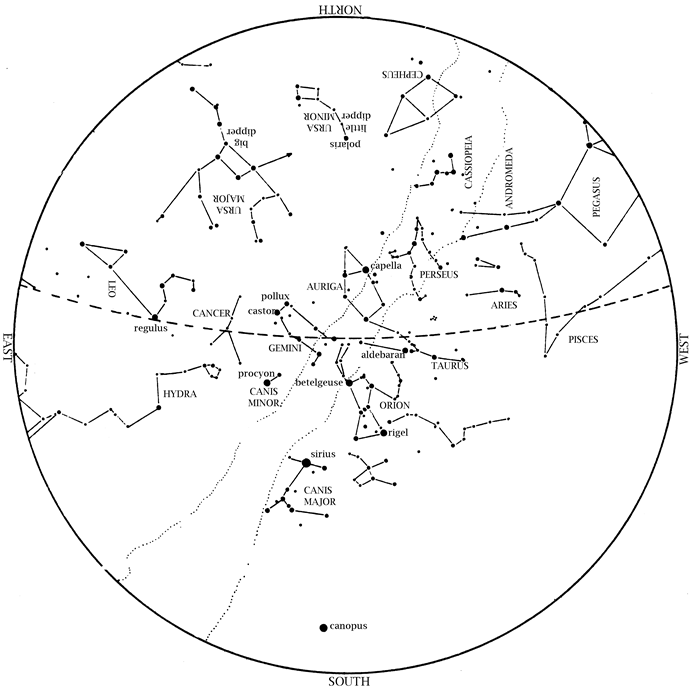
Sky Map: February 2013

Venus now rises while dawn brightens the sky; its morning apparition is ending. Soon Venus willl pass around the far side of the Sun from our perspective, and then reappear in the evening by summer.

Saturn remains in the morning sky this month. Look for it in the south-southwest at dawn.

Brilliant winter stars dominate the southern skies of February. Dazzling Orion is almost due south at dusk. His three-starred belt is halfway between reddish Betelgeuse and bluish Rigel. Orion’s belt points up to Aldebaran in Taurus the Bull. This winter the Bull also contains Jupiter.

Rising with Orion, and far to his left, are the twin stars Castor and Pollux, marking the heads of Gemini, the Twins. You can find Sirius, the brightest star we ever see at night, by drawing a line from Orion’s belt towards the horizon. To Orion’s left, about level with Betelgeuse, is Procyon, the Little Dog Star.

From Sirius, look a little bit to the right and then straight down to the horizon.  If your southern horizon is clear of clouds and tall earthly obstacles, you’ll see Canopus, the second-brightest star ever visible at night. This star is so far south that most Americans never see it, and many star maps made in the USA omit it. (You must be south of 37 degrees north—the latitude of the USA’s Four Corners—for Canopus to rise).

As you view Canopus, keep in mind that the sky we see depends on our latitude as well as on time of year and time of night.

Moon Phases in February 2013:
Last Quarter                  February 3, 7:57 am
New                               February 10, 1:22 am
1st Quarter                    February 17, 2:30 pm
Full                                February 25, 2:28 pm

The New Moon of February 10 is the second New Moon after the winter solstice.  Accordingly, it marks Chinese New Year. On this date the Year of the Dragon ends and the Year of the Snake begins.

On most clear Saturday nights at the George Observatory, you can hear me do live star tours on the observation deck with a green laser pointer. If you’re there, listen for my announcement.

To enjoy the stars in any weather from the comfort of the HMNS Planetarium, click here for a full schedule.

Would you like email updates on current events in the sky, at the planetarium, and at the George Observatory?  If so, send an email to astroinfo@hmns.org.

Rabbit in the Moon

The new moon of Thursday, February 3, was the second new moon after the winter solstice and therefore marked the Chinese New Year, beginning the Year of the Rabbit. The full moon of Friday morning, February 18, just followed the fifteenth day of the first Chinese lunar month, which is known as the Lantern Festival.

The start of this year, then, is an ideal time to look at the features on the moon and see if you can find the “moon rabbit.”  Of course, there is no rabbit in the moon, just dark splotches which some people believe look like a rabbit.  Understanding the rabbit in the moon, then, involves understanding why the moon has dark and light features.

Oceanus Procellarum is the large mare in the center and upper left of this image.
Visible in the upper right is another large mare, Imbrium, and below is the small
round Mare Humorum.

Dark and Light

The moon is not of uniform brightness because it is not of uniform elevation.  The brighter regions are called highlands because they are higher than the darker regions.  Because early lunar observers mistook these dark areas for earthly seas, they are called maria (singular mare; pronounced ‘mah-ree-a’ and ‘mah-ray’), from the Latin word for ‘sea.’   One mare which is much larger than the others has the name ‘Oceanus Procellarum,’ as an ocean is bigger than a mere sea.  Similar, smaller features bear the names lacus (‘lake’) or sinus (‘bay’).  These terms have persisted long after we realized that the Moon has no liquid water and no oceans, seas or lakes.

Lunar Prospector
Image courtesy of NASA

Ancient Basaltic Lava

Lunar mare are in fact ancient basaltic lava flows which filled basins of very large caters on the moon.  Evidence based on radiometric dating indicates that the maria formed between 3.15 and 4.2 billion years ago, with most of the lava flows occurring between 3.15 and 3.8 billion years ago.  This would mean their formation followed the Late Heavy Bombardment (4.1 to 3.8 billion years ago), when countless planetesimals collided with the inner planets of our solar system, forming many craters.  It appears that during this period, some of the larger impacts fractured the lunar regolith.  A few million years later, basaltic lava flowed into the resulting basins.

Why do all the moon’s maria face Earth?

The maria are not spread evenly across the moon’s surface, but instead are almost all on the near side of the moon, which always faces Earth.  The reason for this is a topic of active debate and research among lunar scientists.  Data from the Lunar Prospector mission indicates that under the lunar crust is a layer abnormally high in potassium (K), phosphorous (P), and rare earth elements (REE).  Further, this KREEP material is not spread evenly across the moon but is instead concentrated on the near side, specifically in the Oceanus Procellarum and Mare Imbrium basins.  As potassium and the rare earth elements uranium and thorium are heat-producing, their presence may have favored basaltic lava flows on the near side as opposed to the far side.

Naming Lunar Geography

The mare names we use today go back to Italian Jesuit astronomers Giovanni Battista Riccioli and Francesco Maria Grimaldi.  In 1651, Grimaldi prepared a map of the moon which Riccoli published in his Almagestum Novum.  Folklore associating the first quarter moon with calm weather and the last quarter moon with storms influenced Riccoli as he named the features Grimaldi had drawn.  The western limb of the moon, visible at first quarter, has seas of  Tranquility, Serenity and Fertility (Fecunditatis).  The eastern limb of the moon, visible at last quarter, has seas of Rain (Imbrium), Clouds (Nubium)  and Moisture (Humorum), as well as an Ocean of Storms (Oceanus Procellarum).  Riccoli was not the first to name features on the moon; Michael van Langren and Johannes Hevelius had used different sets of names.  However, when later lunar mapmakers, such as Johann Schröter, used Riccoli’s names, they became standard.  Incidentally, Riccoli also labeled the lunar highlands as terrae (‘lands’), but that nomenclature has not continued to this day.

Moon Legends

Many people around the world have tended to make various pictures out of the darker regions on the Moon’s surface.  The scientific term for our tendency to imagine familiar figures on the moon, or in clouds, on trees, etc., is pareidolia.  Perhaps you are familiar with the man in the moon.  His face consists of Mare Imbrium and Mare Serenitatis (eyes) along with Mare Nubium (mouth).

The Chinese, however, imagined a rabbit in the moon.  Mare Nectaris and Mare Fecunditatis form the tips of the rabbit’s ears, which come together at Mare Tranquillitatis.  Mare Serenitatis marks his head.  The large maria Oceanus Procellarum and Mare Imbrium form the bulk of his body, with Mare Vaopurm as his forelegs and Mare Nubium and Mare Humorum as his hind legs.

In an alternate image, the rabbit is facing the east (left) limb of the moon and is running instead of sitting.  In this view, the head becomes Oceanus Procellarum and the main part of the body Mare Imbrium.  The ears of the previous rabbit, mare Fecunditatis and Mare Nectaris, become the hind legs of this one.  Mare Nubium and Mare Humorun are now forelegs.  Mare Frigoris, a long ‘sea’ near the northern limb of the moon which did not figure into the previous rabbit, becomes a long ear of this one.

Photo edited by Zeimusu:
The rabbit stands by a cooking pot.
Based on the public domain moon image from
image:Luna_nearside.jpg and information on the web.

In Chinese folkore, this is the Jade Rabbit, making the elixir of life for the goddess of the moon Chang’e. In Japan and Korea, the moon rabbit makes rice cakes.  A Buddhist legend tells that the monkey, otter, jackal, and rabbit resolved to offer food to a stranger passing through the forest on the night of the full moon.  The rabbit, able to gather nothing but the grass he ate, offered his own body instead, and was rewarded by being placed in the moon.

Asian societies were not alone in imagining a rabbit in the moon.  In Aztec legend the god Tecciztecatl became the moon god after he hesitated to sacrifice himself in fire to become the sun god.  As punishment, the gods decided the moon would not be as bright as the sun. The Maya also associated a rabbit with their moon goddess.

Today, our Easter holiday is associated with bunnies.  That holiday bears a pre-Christian name which the Venerable Bede attributed to a goddess Eostre, who was associated with rabbits (among other symbols of life and fertility).  Perhaps finding the rabbit in the full moons of March and April can put you in the spirit of the Easter holiday.

Festivals of the World at HMNS Sugar Land

Come join us this Saturday, December 11 from 10 a.m. til 2 p.m. at HMNS at Sugar Land for our Second Saturday event Festivals Around the World.

In cooperation with PACE (Parents for Academic Excellence), the Houston Museum of Natural Science at Sugar Land will help children appreciate 7 different cultures from around the world and what makes each one unique. Each culture will have a display, crafts and story time.

For Chinese New Year you will see Chinese clothing, a table setting, zodiac animals and pictures of Chinese New Year celebrations around the world. Participants will learn about the Chinese zodiac, make a zodiac card and complete a zodiac word search.
Story time will feature information about the Chinese Dragon Dance.

The Hanukkah display will feature clothing and jewelry for the holidays, decorations for the holiday season and an example of a traditional meal. For crafts, children will create a Menorah using their hands as patterns and a paper dreidel.

The Cinco de Mayo celebration will feature traditional Pueblan clothing, a display of Cinco de Mayo party decorations and a demonstration of the traditional way of making salsa. Visitors will make a papel picado, which is a type of traditional Mexican folk art.
Story time will feature a Mexican dance!

The festival known as Eid will feature displays of a prayer rug, the Koran, colorful illuminations, crescent moon, patakas (religious flags) and gifts. For crafts, children will make an Eid greeting card and a personal prayer rug.

The Kwanzaa display will feature a traditional table setting with an explanation of what each item means for the holiday. You will see decorations, food, flags, a Unity Cup and much more. Children will make an almost beaded headband.

The Diwali festival will feature clothing and jewelry for the holiday as well as traditional decorations for the holiday season. The craft will be making a paper lantern.
Story time will feature an Indian dance.

The Christmas season will feature displays of holiday items and decorations. For the crafts, children will make reindeer from their footprints and handprints and create a Christmas card using their fingerprints.
Story time will feature Christmas pop-up books.

Parents, bring your camera! Santa will be at the Houston Museum of Natural Science at Sugar Land for the Second Saturday celebration of Festivals Around the World.

This event is included with the price of admission to HMNS at Sugar Land.

Happy New (Chinese) Year!

On Sunday, Feb. 14, while we were observing Valentine’s Day, a much bigger celebration got underway in the Far East.  That was the  Chinese New Year, the day when the Year of the Ox ended and the Year of the Tiger began.  And the celebration is still ongoing, as it lasts until the Lantern Festival on the 15th day of the month (this year, Feb. 28).

Lanterns
Creative Commons License photo credit: ken2754@Yokohama

Like most Americans, I learned the sky as imagined by westerners around the Mediterranean basin, with images from Babylon, ancient Egypt, ancient Greece and Rome, and star names preserved during the Middle Ages by Arabs. So I find it fascinating to think of an entirely different culture and how they imagined the night sky. The Chinese New Year celebration is a perfectly appropriate time to do this, especially since objects in the sky, in particular the moon and Jupiter, serve as the basis of the ancient Chinese calendar.

The date of Chinese New Year varies; it can occur as early as Jan. 21 or as late as Feb. 19. However, anyone familiar with the lunar cycle can easily predict the date for a given year. That’s because China’s New Year always begins with the second new moon after the winter solstice.

Our Gregorian calendar is a solar calendar, based on the apparent position of the sun (and thus, on the Earth’s orbit around the sun).  However, the apparent position of the sun compared to the stars is difficult to observe.  Much more readily observable are the phases of the moon.  Thus the Chinese, like many ancient cultures, adopted a lunar calendar, measuring months from new moon to new moon.  Unlike the Islamic or ancient Roman calendars, the Chinese calendar begins months with the dark of the moon–the day the moon is invisible, not the first slender crescent seen at dusk.

Full Moon
Creative Commons License photo credit: Andréia

It would be convenient if one year equaled an even number of phase cycles. In fact, however, the moon takes about 29.5 days to go through one phase cycle, so 12 such cycles is 354 days.  This is significantly less than the solar year of 365.25 days, so a purely lunar calendar quickly becomes disconnected from the seasons and useless as a guide for when to plant or harvest.   To keep their lunar months connected with the seasons, the Chinese added a rule: the second-to-last lunar month must contain the winter solstice.  If the old crescent moon of the eleventh lunar month is waning towards new and the winter solstice has not yet happened, that month is repeated.  Similar rules exist for the second lunar month (which must contain the spring equinox), the fifth lunar month (which must contain the summer solstice), and the eighth lunar month (which must contain the fall equinox).  Accordingly, the first new moon after the winter solstice always begins the last month in the Chinese year, and the second new moon after the solstice begins the next year.

Chinese astronomers noticed that every twelve years, Jupiter reappears next to the same stars.   (This is because Jupiter takes 11.86 years to orbit the Sun.)  There were twelve months in a typical Chinese year (although occasionally one was doubled, as explained above).  Also, the Chinese divided the day into twelve double-hours.  They used a system of twelve ‘Earthly Branches’ to designate the months of the year and the double-hours in a day.  Jupiter’s motion in the sky established a cycle of years analogous to the cycles of months and double-hours.  Thus Jupiter became the ‘Year Star’ (Suixing) and years, too, were designated with the Earthly Branches.

Lion Dance
Creative Commons License photo credit: geoftheref

Later, as a mnemonic device, the Chinese began to associate the Earthly branches with animals.  (Sources disagree as to exactly when.)  Legends tell that Buddha (or the Jade Emperor) summoned all of the animals to him; each of the first twelve to appear became associated with an Earthly Branch.  The twelve animals are:

1) Rat  2) Ox  3) Tiger  4) Rabbit  5)Dragon  6)Snake  7)Horse  8)Sheep  9)Monkey  10)Rooster  11)Dog  12)Pig

The signs of the Chinese zodiac, then, unlike those of the western zodiac, are not constellations in the sky.  The most well known of the Chinese constellations are the 28 ‘lunar mansions.’  These are small groups of stars very roughly arrayed along the ecliptic, which is the apparent path of the sun, moon and planets across the sky.  As you’ll see in the links below, the Chinese used some stars, such as those in Orion, that are too far from the ecliptic for the moon to pass through them.  The 28 mansions were subdivided into four groups of seven; each group of seven represented one of four Chinese animals associated with the directions and the seasons:

1) The Blue/Green Dragon (Qing Long) of the East, associated with spring.  Note that the ancient Chinese color word qing was quite broad in meaning.  Blue and green were considered different shades of this broadly defined color.

2) The Red Bird (Zhu Que) of the South, associated with summer.   This mythical bird, with red and orange plumage, is distinct from the feng huang, also called the Chinese phoenix.

3) The White Tiger (Bai Hu) of the West, associated with autumn.

4) The Black Tortoise (literally Dark Warrior, Xuan Wu) of the North, associated with winter.  Xuan Wu was always shown as a tortoise with a snake wrapped around it, reflecting the folkloric belief that all tortoises were female and needed to copulate with snakes to reproduce.

Of the stars in tonight’s evening sky, those in Orion and Taurus form part of the White Tiger, while Gemini and the dimmer stars south and east of it belong to the Red Bird.

Along with the four large animals, Chinese astronomers defined three large constellations known as the three enclosures.  The largest of these is the ‘Purple Forbidden Enclosure‘ (Zi Wei Yuan) which includes all those stars near the North Pole of the sky which never set as seen from mid-northern latitudes.  The enclosure is ‘forbidden’ because it includes the North Star, which was the Emperor of Heaven because it always remains in one spot while other stars seem to go in circles around it, as if paying court.

The ‘Supreme Palace Enclosure‘ (Tai Wei Yuan) actually rises in the late evening in February.  Look east about 9 tonight for a set of stars in the shape of a backwards question mark.  We see this as the head of Leo, the Lion.  Rising under the backwards question mark is a right triangle of similar brightness.  For us, this is Leo’s hindquarters, but in China, it’s the northwest corner of the Supreme Palace enclosure.  The other side of this enclosure is a semi-circle of stars westerners recognize as part of Virgo, the Virgin.

The final enclosure, the ‘Heavenly Market Enclosure‘ (Tian Shi Yuan), won’t rise until very early in the morning in February, and isn’t in the evening sky until late May.  It centers on our constellations Ophiuchus and Serpens (Caput and Cauda), just north of the bright summer constellations Scorpius and Sagittarius.

So, I wish everyone a happy Year of the Tiger.  I’ll celebrate it by looking at the stars in a way I ‘m not accustomed to seeing them.