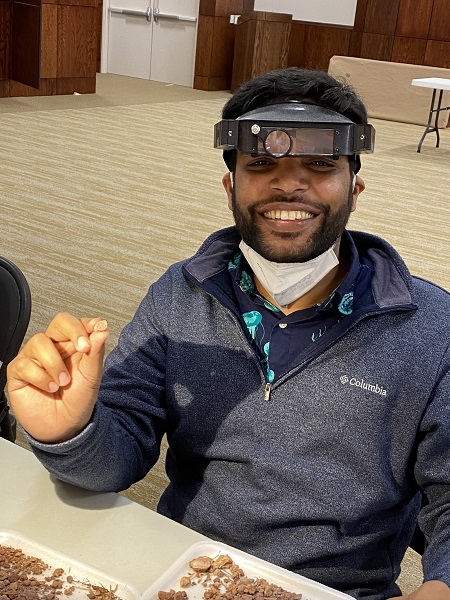
Sweet lobotomies: A sugar skull how-to for fellow craft addicts

Fall is a favorite time of year for many people in the Education Department. The summer rush is over, the weather has gone from sweltering to just hot and Dia De Los Muertos is approaching. When it comes to Day of the Dead crafts, some might say we have an addiction. But we don’t! We can stop crafting whenever we want to … we just don’t want to.

To share in the spirit of this holiday for craft addicts, we’re going to show you how to make sugar skulls. They are fun and easy, but you should be prepared to get a little sticky, and the process does take a bit of time.

Completed sugar skull!Ingredients:
5 lbs of sugar
¼ cup of meringue powder
3+ tablespoons of water

Supplies:
A big bowl
A sugar skull mold (see notes below)
Scraps of cardboard sized to your mold
Your hands (because a spoon just doesn’t cut it!)

Procedure:
1.    Dump your 5 lbs. bag of sugar into your bowl.
2.    Add ¼ cup of meringue powder. We used a rounded ¼ cup, so precision isn’t super important here. Meringue powder is widely available at any store selling cake decorating supplies.

Sweet lobotomy! A sugar skull how-to3.    Mix the sugar and powder with your hands.
4.    Add 3 tablespoons of water half a tablespoon at a time and mix with your hands. You are aiming for the sugar to stick to itself. To test this, sprinkle a handful into your open palm. Close that palm into a fist and then open your hand. If the sugar stays in the shape of your closed fist — however briefly — you’ve got a winner.  If it is too powdery or won’t stick, add more water. If it is too mushy, add a bit more sugar.
5.    Once you’ve got it to the right consistency, get your mold. We’ve cut ours apart for ease of use, but you can leave them as a whole sheet too.
6.    Put the mold in one of your hands face down.
7.    Pack the sugar mixture into the mold like you would brown sugar for baking.  It is okay if it is overly full as long as it is tightly packed.
8.    Using your cardboard scrap, scrape the excess sugar off and back into the bowl.  Your skull’s back, if viewed from the side, should be totally flat.
9.    Place the cardboard scrap on the back of your skull so it covers all the sugar.

Sweet lobotomy! A sugar skull how-to10.    Press the mold and cardboard together.

Sweet lobotomy! A sugar skull how-to11.    Flip!

Sweet lobotomy! A sugar skull how-to12.    Place both pieces on the counter together.
13.    Lift the mold off.  Ta-da!

Sweet lobotomy! A sugar skull how-to14.    Repeat this process, making sure to make enough backs and fronts. Making sugar skulls is a very forgiving process. If you aren’t 100 percent satisfied with your work, dump it back into the bowl and start over. If your skull is dried and has a defect, cover the defect with icing.  No worries!
15.    After 4 to 8 hours, depending on the humidity, your skulls should be stiff to the touch and you can gently pop them off the cardboard.
16.    Take a skull and place it in your hand face down.
17.    With a metal spoon, lobotomize your sugar skull. You will scoop out all the inside goodness and put it back in your bowl.  If your skull isn’t dry enough, it will crumble in your hand. This isn’t a problem – just wet your hand, mix up the bits and do it again. If your skull is too hard, you won’t get any scoopings. This isn’t the worst thing in the world, either, but no scoopings means heavier skulls and it is a bit wasteful.

Sweet lobotomy! A sugar skull how-to18.    Re-wet the scoopings, if necessary, and use them to make a few more skulls!

Sweet lobotomy! A sugar skull how-to19.    Stay tuned for a second post on how to make royal icing to cement and decorate your skulls.

If you are nervous about the process, don’t have the time or just don’t want your floors to be sticky, join us on Monday Oct. 22, for an evening workshop on Day of the Dead and Sugar Skulls.

Editors’ Notes:
If you live in Houston, then you’re in for a treat. Casa Ramirez in the Heights is your one-stop-shop for Day of the Dead items, including a variety of sugar skull molds. Senor Ramirez is old school, however, so there is no website and definitely no online ordering option. This is offset by the instant gratification of walking away with your molds and not having to pay shipping.

If you are not from Houston, you might want to check out MexicanSugarSkull.com, a pretty terrific online store that sells just about anything you can imagine when it comes to Dia de Los Muertos. Happy lobotomizing!

Distinguished Lecture Series: Gain new perspective on a local Civil War hero April 24

Many Houstonians are familiar with the story of the Battle of Sabine Pass. On September 8, 1863—against long odds—the Confederate Davis Guards and Lt. Dick Dowling defeated a U.S. Navy fleet that entered Sabine Pass from the Gulf of Mexico, foiling a Union plan to capture Houston and the state of Texas.

dick dowling guest blog

For a century and a half, the Irish Houstonian Richard W. “Dick” Dowling has been remembered as a Confederate hero who saved Texas from invasion by federal troops with his victory at the Battle of Sabine Pass. His statue still stands in Hermann Park near the Houston Museum of Natural Science.

Yet the stories Houstonians have told about Dowling have also changed over time, and some stories have not yet been fully told. Legends about the Battle of Sabine Pass have also overshadowed the fact that Dowling’s victory delayed emancipation in Texas and obscured the heroism of several fugitive slaves who fought in the battle for the Union.

Historical researcher Dr. W. Caleb McDaniel has uncovered a fresh view of Dowling’s famous battle from the perspective of another Houston landmark, Emancipation Park, by placing Dowling and Sabine Pass in the context of slavery and emancipation both before and during the Civil War.

In the final lecture of the Discovering the Civil War Distinguished Lecture Series on Tuesday, April 24, Dr. Caleb McDaniel will present “Dick Dowling and the Battle of Sabine Pass: The View from Houston’s Emancipation Park.”

“My lecture will use recent research about the Battle of Sabine Pass to show how the battle impacted enslaved people in Texas and Louisiana and will also discuss the role of African American sailors in the battle on the Union side,” Dr. Caleb McDaniel explains.

Audience members will also be introduced to a new online archive of historical documents and materials related to Dowling, enabling them to study Dowling on their own and trace the changes in his image over time in Houston and beyond.

dick dowling guest blog

What: HMNS Distinguished Lecture, “Dick Dowling and the Battle of Sabine Pass: The View from Houston’s Emancipation Park”

When: Tuesday, April 24, 6:30 p.m.

Where: The Houston Museum of Natural Science, 5555 Hermann Park Dr., 77030

Click here for advanced tickets.

W. Caleb McDaniel

Dr. W. Caleb McDaniel is assistant professor of history at Rice University. Since receiving his Ph.D. at Johns Hopkins University in 2006, he has published articles on the Civil War era in several scholarly journals and currently teaches undergraduate and graduate courses on the Civil War at Rice. More information about his work is available on his homepage.

Emancipation Park

In 1872, Rev. Jack Yates and his congregation at Houston’s oldest African American Church, Antioch Missionary Baptist Church, along with the help of  the members of Trinity Methodist Episcopal Church and other community leaders, purchased the land the park stands on to celebrate Juneteenth. This community park was later donated to the City of Houston in 1916.  Located near downtown at the intersection of Dowling and Elgin Streets, Houston’s Emancipation Park  is now designated with a State Historical Marker. The Park is cared for by the City of Houston with support from Friends of Emancipation Park.

Why James Delgado > James Cameron: See a real underwater explorer speak April 12

James Cameron’s got nothing on Dr. James Delgado. Although the multimillionaire and filmmaker made a historic dive Monday to a depth of 35,576 feet, it’s Delgado who headed up the historic excavation of the R.M.S. Titanic – the inspiration for that other guy’s most famous film.

james vs

On the eve of the 100th anniversary of the Titanic’s sinking in April 1912, new images were released in the April 2012 edition of National Geographic that depict the entire wreckage for the first time in a single frame.

For the first time ever, the boat’s full expanse is photographed at its resting place more than 2 miles beneath the Atlantic Ocean.

Although the images look as though they were shot from a distance, the ocean depths are far too dark to light the wreck powerfully enough – and doing so would be dangerous to the ship’s remains. Instead, the images were assembled mosaic-style by experts at the Woods Hole Oceanographic Institution and took months to complete.

To create an accurate image of the full wreckage, researchers layered optical data on top of sonar images gathered from an exhibition in 2010 that is widely regarded as the most extensive research and recovery trip to date. During that trip to the wreck site, the eighth since its discovery, three robots circled the boat using side-scan and multibeam sonar to capture hundreds of images per second.

Titanic | James Delgado appearance

Delgado, the chief scientist for the excavation and National Oceanic and Atmospheric Administration Director of Maritime Heritage, told the National Geographic the reconstructed images were “a game-changer.”

“In the past, trying to understand Titanic was like trying to understand Manhattan at midnight in a rainstorm – with a flashlight.”

Delgado will be at HMNS on April 12 to discuss expeditions to the wreck site and the technology that has made such imaging possible.

In addition to discussing his own historic visit to the ocean floor, Delgado will outline options for the Titanic’s future preservation.

To reserve tickets, click here!

Stage-five clingers: Learn to grow epiphytes with Zac Saturday, March 24

As the horticulturist for the Cockrell Butterfly Center conservatory, I get asked a plethora of gardening questions. The most frequently asked question (other than “How’s Lois?”) has got to be “How do you get your orchids to grow on trees?”

Orchid Show at HMNS!

I explain to visitors that most orchids are epiphytic, which means that they grow on the trunk and branches of larger trees. To do this, they have developed ingenious ways to obtain water and nutrients without the need of soil. Not to be confused with parasites, epiphytes take nothing from the tree they attach themselves to. Notable examples include ferns, orchids and bromeliads, but the most familiar epiphyte to people here in the south is a wispy bromeliad by the name of Spanish moss.

There seems to be a common misconception that growing orchids is reserved for only the most experienced gardeners, but from my experience, this is not always the case. In fact, orchids seem to thrive on neglect; the most common cause of orchid death is over-watering.

epiphyte orchid

To learn more tips and tricks for epiphyte growing, join me for the HMNS adult education class How to Grow Orchids, Bromeliads and Other “Air Plants”  from 9 to 11 a.m. this Saturday the 24th in the Cockrell Butterfly Center. The class includes a behind-the-scenes tour of the Butterfly Center, followed by a hands-on class where attendees will learn how to propagate, divide, mount and fertilize their own epiphytes. And finally, everyone goes home with their very own orchid to start (or add to) their collection!