Tag Archive for 'NASA'

Go Stargazing! June Edition

Size comparison of terrestrial planets (left to right):
Mercury, Venus, Earth, and Mars

Saturn is now in the south southwest at dusk.  Look just to the west of due south, about 2/3 of the way up from the horizon to the zenith, and you will see Saturn in the sky.

Venus remains high in the evening sky during June.  Face west at dusk and look for a point of light that outshines everything in the sky but the sun and the moon.

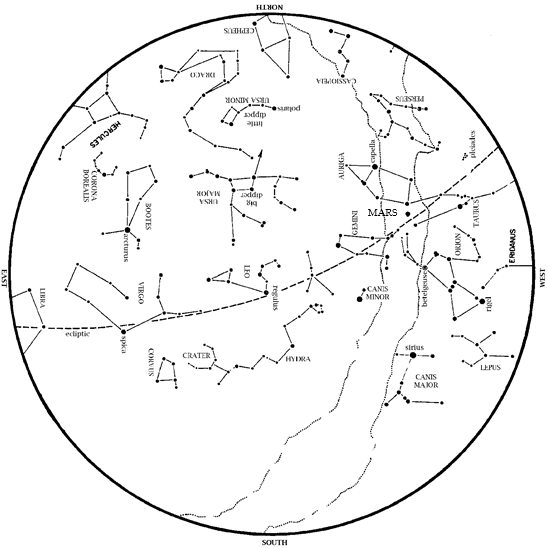
Mars is high in the evening sky, although not as bright as it was in winter.  Since January 29, Earth has been pulling ahead of Mars on its faster orbit.  As a result, Mars gets slightly dimmer each night for the rest of 2010.  As June opens, Mars is approaching the star Regulus in Leo from the right.  Mars is right next to the star on June 5, then pulls away from the star to the left after that.  Look high in the west at dusk for a reddish point of light.

Jupiter is in the south-southeast at dawn this month.  It outshines all stars in the sky, so it’s easy to find.

Spring stars are high in the south and west.  A distinct backwards question mark shape outlines the mane and forepaws of Leo, the Lion.  Three stars forming a right triangle are to its upper left; they mark Leo’s hindquarters.  The Big Dipper is as high as it ever gets in the north at dusk. You can extend the curve of its handle to ‘arc to Arcturus’ and then ‘speed on to Spica.’  These stars high in the east and south, respectively, by dusk tonight.  Arcturus, by the way, is the fourth brightest star we ever see at night, but the brightest one Americans ever see in all of June and July.

In the east, look for the enormous Summer Triangle, consisting of the stars Deneb, Vega, and Altair.   This triangle is up all night long in June and July, hence its name.  Scorpius, the Scorpion, is in the southeast at dusk.  Sagittarius, the Archer, known for its ‘teapot’ asterism, rises just after dusk on June 1, but is up by nightfall on June 30.

Moon Phases in June 2010:

Last Quarter                  June 4, 5:13 p.m.

New Moon                      June 12, 6:14 a.m.

First Quarter                  June 18, 11:30 p.m.

Full Moon                        June 26, 6:30 a.m.

It's ba-ack!
Creative Commons License photo credit: ronnie44052

The full moon of Saturday, June 26, will set in partial eclipse.  At 3:55 a.m., the moon first touches the penumbra of the Earth, the region where Earth partially blocks the sun.  The main event starts at 5:16 a.m., when the moon begins to enter the umbra, or the shadow itself.  The moon is not truly aligned with the Earth and sun this time, though, so it will not go all the way into the shadow.  This is why we have only a partial eclipse, with only the north (upper) limb of the moon in shadow.  The moon is still partly inside the umbra as it sets at 6:25 a.m.  (Although we no longer see it, the moon remains partially eclipsed until 8 a.m.)

This eclipse is merely a ‘warm-up’ for the spectacular total lunar eclipse we will have just after midnight on December 21.

At 6:29 a.m. on Monday, June 21, the sun is directly overhead at the Tropic of Cancer. Therefore, this day’s midday sun as high as possible in our skies.  This, then, is the moment of the summer solstice.  Those of us in the Northern Hemisphere enjoy more daylight on this day than on any other day of the year.

del.icio.us this | digg this | Stumble It!      Email This Post Email This Post

Webisode: A Wild Ride [Hubble 3D]

The shuttle that NASA uses is often referred to as “The Flying Brick” because they land it without using any engine power. Because it is so difficult to both fly and land, astronauts prepare for their space flights using a replica cockpit. The simulator, which has the exact same controls as the actual space shuttle, can duplicate errors and system failures that might plague a crew on an actual mission.

Learn about the flight simulator in this week’s webisode:

Check out Hubble 3D in the Wortham IMAX Theatre. This stunning 3D film reveals the cosmos as never before, allowing viewers of all ages to explore the grandeur of the nebulae and galaxies, the birth and death of stars, and some of the greatest mysteries of our celestial surroundings. If you come on Tuesday after 2 p.m., tickets are just $6!

Did you miss the first four webisodes?
Astronaut Mike Massimino (he’s on Twitter!) takes us on a tour of the spaceship and explains how they train for missions.
Mike explains how difficult it is to get into space suits.
See the largest swimming pool in the world and how the astronauts use it to train for space walks.
Learn about the first mission to repair the Hubble Telescope.

del.icio.us this | digg this | Stumble It!      Email This Post Email This Post

Webisode: Space is an Open Book Exam [Hubble 3D]

Tomorrow is the 20th anniversary of the launch of the Hubble Telescope. To celebrate 20 years of amazing images and deep-space discovery, we’ve got an all-new Hubble 3D webisode!

Check out the video below for a fascinating tour of the space shuttle simulator with astronaut Mike Massimino (he’s on Twitter!) Find out why NBA players would feel uncomfortable on the shuttle, how astronauts deal with a space bathroom, explore the flight deck, and learn why space is like “an open book exam.”

Want to celebrate the Hubble’s 20th?
Check out Hubble 3D in the Wortham IMAX Theatre. This stunning 3D film reveals the cosmos as never before, allowing viewers of all ages to explore the grandeur of the nebulae and galaxies, the birth and death of stars, and some of the greatest mysteries of our celestial surroundings.

Did you miss the first three webisodes?
Mike explains how difficult it is to get into space suits.
See the largest swimming pool in the world and how the astronauts use it to train for space walks.
Learn about the first mission to repair the Hubble Telescope.

del.icio.us this | digg this | Stumble It!      Email This Post Email This Post

Webisode: Getting Dressed [Hubble 3D]

As we gear up for the 20th anniversary of the Hubble Launch (April 26), this week we bring you another webisode from behind the scenes of the IMAX film Hubble 3D. In this week’s episode, astronaut Mike Massimino talks about the difficulty of getting into his space suit. It takes two people just to help him pull his pants on!

Did you miss the first two webisodes?
See the largest swimming pool in the world and how the astronauts use it to train for space walks.
Learn about the first mission to repair the Hubble Telescope. 

Don’t miss your chance to see Hubble 3D in IMAX. Hubble 3D will also reveal the cosmos as never before, allowing viewers of all ages to explore the grandeur of the nebulae and galaxies, the birth and death of stars, and some of the greatest mysteries of our celestial surroundings. Click here to read about the Hubble Telescope and to view the trailer for Hubble 3D in IMAX.

del.icio.us this | digg this | Stumble It!      Email This Post Email This Post